






.jpg?crc=4257584689)


_web.jpg?crc=282450513)


SUBSCRIBE FOR FREE to the Grapevine News Online and to the monthly e-book edition of the Grapevine Community Weekly. Our online news platform and monthly newspaper is about real local news and events. We will not spam you or share your details with third parties.

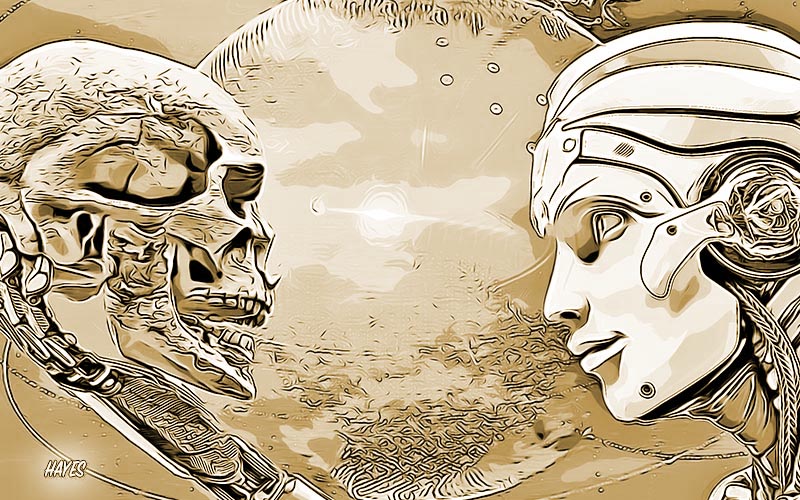
AI's 10 percent extinction threat
Last weekend, Anthropic CEO Dario Amodei said that the risks now being posed by today’s advanced Artificial Intelligence (AI) tools were simply too great to continue development at the same breakneck pace. “AI’s progress over recent months — driven by AI systems that can improve on their own without human intervention — could outrun our ability to understand and control these systems, and so must be pursued very carefully, if at all,” he said.
Dario Amodei, Sam Altman and Elon Musk, are all now calling to slow down the development of AI. But if anyone has the power to slow down AI development it's them! So, why don't they take the lead in the AI gold-rush?
It should go without saying that multi-national corporate giants calling for regulation should be treated with deep suspicion, especially when there is a link with China. So, rather they just regulate AI development, shouldn't global governments be heavily regulating data centres instead.
But despite Amodei screaming regulation to quell the AI annihilation of humanity, it seems that he is not enamoured with other forms of regulation - protecting content creators from having their work pillaged for the benefit of AI companies like Anthropic. What it seems he is clearly terrified about is China catching up with the U.S. on AI.
16 September 2026
ALAN HAYES
THE recent revelation about AI thinking for itself is not only distributing, it should be of enormous concern to our government. Dario Amodei (Anthropic CEO) pointed to AI systems that will soon be capable of pursuing their own goals, potentially destroying humanity in the process. And there’s increasing likelihood that a nation or person bent on widespread destruction will enlist AI to create novel viruses or toxic substances that wipe us all out. (Last Week, Anthropic said it had stopped efforts by scientists who were conducting research that potentially could lead to the development of biological weapons.)
The July hack of the AI software company Hugging Face by a swarm of as many as 1,200 AI agents that escaped from a test environment at OpenAI revealed that the AI agents had been engaged in a range of online activity that had gone unnoticed by the world’s largest AI companies, including Anthropic.
Amodei’s warning comes just days after Anthropic researcher Jacob Coxon resigned from the company, saying his former employer and its rival OpenAI are racing to build technologies that “could kill us all by the end of the decade". Minutes after Coxon posted his resignation, Evan Hubinger, whose job at Anthropic is to lead research about steering and controlling future artificial-intelligence system confirmed: “We really do earnestly believe AI could kill all humans!” Hubinger put the extinction risk over the next decade at over 10 percent.
Comments to slow down on AI caused tech stocks to fall in Europe and the the US following the calls from the AI bosses and wider tech industry to slow down the development of the technology.
Not a day now passes without some technophile pronouncing that humanity is on the cusp of a wondrous new era for humanity or a technophobe warning we’re nearing the destruction of humanity. Who to believe? The problem is that when the head of one of the largest AI companies confirms that a problem exists, it's time to wind back the rush to destroy humanity. Yet in Australia, we have a Prime Minister who is besotted by the dollars that AI allegedly says it will bring to our nation. Riding on the back of those dollars is the excessive use of water - in a country that experiences severe droughts - and the excessive burning of fossil fuels to keep the AI data banks alive. So, Prime Minister Albanese, are your eyes wide open now or do they remain wide shut?
A few days ago my colleague in America told me that he had a conversation with the top executive of a corporation specialising in AI, who told him not to worry, and assured him that the chance of AI wiping out humanity is “no more than 10 percent.”
He was astounded that he was so complacent about a technology he believed had a 10 percent chance of ending human life. If humanity were acting sanely, we would not accept this risk. At the very least, government would demand that those working on AI pause their work until we know more and can erect guardrails to protect humanity against this.
So, why aren’t we doing this? Because of one simple problem - human greed and government, particularly in Australia, more interested in balancing excessive spending.
But, then of course, you have the other side of the coin – a lunatic in the Whitehouse, who will stop at nothing too win. Trump said about the Ai concerns: “We're leading China in AI, we're the most sophisticated country in the world, and frankly I want to keep it that way,” he said. “Whoever wins AI, wins.”
Trump responded further by posting a series of erratic social media posts (when are they not?), claiming there is a “sick conspiracy against AI and data centres”. He declared last Monday that the only guardrail AI really needs is a “strong and smart president, and the USA has that, in spades!”. He then followed up with: “Concerning AI, when, in the history of business, did anyone see the leaders of an industry call for regulation that, if strongly implemented, will drive them into oblivion and bankruptcy? AI taking over the world, destroying humanity, and all other things bad, is a hoax.”
"I'm not happy about this," the Mad King went on to say, "and want them to change their thinking. AI, and data centres, will be the greatest economic development engine in history — bigger than oil, gold, diamonds, or even the internet. It will not be stopped by brilliantly-run destructive forces during the term of President DONALD J. TRUMP!”
To back up Trump’s insane comments, Texas senator Ted Cruz pitched in: “I’d rather they be American killer robots and not Chinese killer robots.” And in Australia? Assistant Minister for Technology Andrew Charlton expressed concerns some AI models being built were not released due to safety concerns. Charlton told the Australian Financial review: “No company should be releasing a model that is not safe. It's alarming when the people building these models start saying ‘slow down’.”
The problem we now face, however, is that both Anthropic and OpenAI are readying themselves to go public in deals that could value the companies in the trillions based on the current and future capabilities of their models. This will immediately create many AI billionaires and millionaires, and it follows a similar Initial Public Offering (IPO) from SpaceX, and a likely future IPO for OpenAI.
Quite simply, with this much money on the table, no one has an incentive to slow down. Easy for Amodei and other AI executives to issue dire warnings, while pulling out all the stops in their competition with other AI executives and corporations.
In addition to greed, many people involved in AI have refused to slow down their AI development. Why? Because China is hot on their AI tail.
The “DeepSeek Moment” in early 2025 put Chinese AI on the map. The release of Moonshot’s Kimi K3 in July and A/ai’s GLM-5.3 Moonshot’s Kimi K3 a few weeks ago caught the attention of global security experts, especially when Z.ai beat Anthropic’s famous Mythos model on one measure of cyber-hacking capabilities.
These experts concede the dangers of unrestricted AI development but say China has no such concerns, and will move ahead on AI as quickly as it can because China understands that AI is the key to geopolitical power in the future. But can you trust China's double-speak? NO!
Some also say that the only reasonable way forward in AI development is by way of the “mutually-assured destruction” strategy, the same way the major players pursued co-operation with each other to prevent blowing up the planet with nuclear missiles — create a sufficiently credible threat that we’ll use AI agents on them if they use them on us, so as to prevent either side from using AI on the other.
But can the world be guaranteed that both major players - the U.S. and China - have a sufficiently shared incentive to implement strict safeguards against these catastrophic risks, and to regulate the pace of AI development until safeguards are in place? UNLIKELY! Self-interests will always dominate.
Back home in Australia
It has been reported by the Nine papers that OpenAI has said it is open to training its models in Australia, but, of course, it is not that simple.
OpenAI's senior vice president, Ann O'Leary, dangled the carrot of Australia being the first country outside America to host AI model training for the company, but only if that pesky copyright issue is resolved first.
“No other place in the world has done [AI training] this yet, and so the question is: is Australia going to be the first? And that's really a copyright question more than a renewable energy question,” O'Leary said. “Our company isn't ready to have that conversation if we can't get through the gating problem of the copyright barriers.”
O'Leary has been reported as saying that the tech companies were planning for self-regulation because authorities weren't keeping pace. “We feel that we can't wait for government to catch up with us,” she said. “We're very happy to be in conversation and dialogue with them, but in the meantime we have to be not only doing our own voluntary action, but meeting with one another.”
Can we really trust tech companies to self-regulate and to pay their fair share for use of intellectual property? The evidence so far clearly shows otherwise! As the owner of a voluminous amount of intellectual property, primarily through the many books that I have authored, it concerns me greatly that AI is already breaching my copyright without paying to use it - this will only continue under the guise of a self-regulation.
Following tech CEOs Dario Amodei, Elon Musk and Sam Altman call for urgent action to slow down the arms race on AI, citing a threat to humanity, Senator Hanson-Young asked the Government in Question Time on Monday if it would commit to a moratorium on data centre approval and construction or to making upcoming legislation on data centres retrospective. Senator Wong, representing the Prime Minister, failed to answer the question.
“When the three leading CEOs of AI companies are telling you there’s a problem with the hyper speed of AI, its time for governments to listen," Senator Hanson-Young said.
“Instead, the Albanese Government seems determined to roll out the welcome mat for the construction of dozens and dozens of data centres across Australia.
“New York and Texas have imposed moratoriums on the building of new data centres following fierce backlash from local communities. It’s time for Australia to follow suit.
“With American communities strongly rejecting data centres, Australia is becoming a destination of choice for AI companies because of our lack of regulation.
“Right now, it’s the wild west for cowboy data centre operators, there are no rules. We need to take a pause while we get the settings right.
“The Government has rightly acknowledged the need for a regulatory framework but while they are dragging their feet to bring a bill to the parliament, data centres are popping up all over the country.
“This extractive industry is already taking our energy and water and giving little back to the Australian community.
“Unless we have a moratorium or a commitment that the future laws will be retrospective, it’s a green light to the industry to get in quick and build, build, build before the rules are put in place."
Meanwhile, Australian Signals Directorate director-general Abigail Bradshaw has been reported as saying the country needs an artificial intelligence “early warning system” to defend against the dangers of the technology. We need a stronger solution to the growing risks of AI that just hollow words. Our government needs to understand that human greed greed and self-serving interests are driving AI technology and that AI companies aren't interested in the end game - you don't leave an open lolly jar for the kids to have free access to it.
What can and should be done?
If the United States had a sane president and a halfway intelligent administration, it would be telling AI corporations to slow down until guardrails have been put in place, and negotiating with China (and other powers) to do the same. But of course, the United States has a lunatic in the White House and the world is already suffering from his inane machinations.
It is should be noted, however, that my American colleague told me that the White House recently asked top AI model developers to voluntarily submit their models to the government for testing up to 30 days before they were released. But so far,the U.S. government hasn’t publicly released information about the process and many people in the industry still say nothing is being done.
So, while the world ponders the AI revolution outcome, the responsibility to ensure that we as a species is protected from rogue AI agents will fall to global governments — whose leaders, hopefully, will heed the warnings. These warnings must be high on the agenda of the Albanese Government, which, hopefully, would exercise responsible control of the AI rush in Australia – but don’t bet on it.
There's been a lot of lip service from our government, which is tantamount to same inaction globally - so, there is reason to be concerned.
The reality: AI data centres have received a great deal of negative attention, but the likelihood that AI will eliminate thousands of jobs has received even far less attention. The 10 percent (or so) likelihood that AI will wipe out the human species hasn’t received nearly the attention it deserves.
So, as my American friend said to me in our telephone conversation two days ago: "A ten percent chance of extinction is too high for humanity to take no action."
Yet the risk of a climate crisis causing hundreds of thousands of premature deaths, destruction of ecosystems and species, and massive economic damage is 100%. And don't kid yourself, where're in the midst of it now - just take a good look around and you'll realise that it's happening in real time and will grow steadily worse with no endpoint, given the global failure to curb CO2 emissions.
The climate crisis is causing hundreds of thousands of premature deaths, the destruction of ecosystems and species, and massive economic damage. Data centres will only exacerbate the problem, so why is our government besotted by them - it's time to say NO to the tech giants.
