






A key climate goal is dead
Eleven years ago in Paris, world leaders agreed to cap global temperature rise below 1.5 degrees Celsius above preindustrial levels. Climate scientists warned that crossing this threshold would dangerously disrupt our way of life.
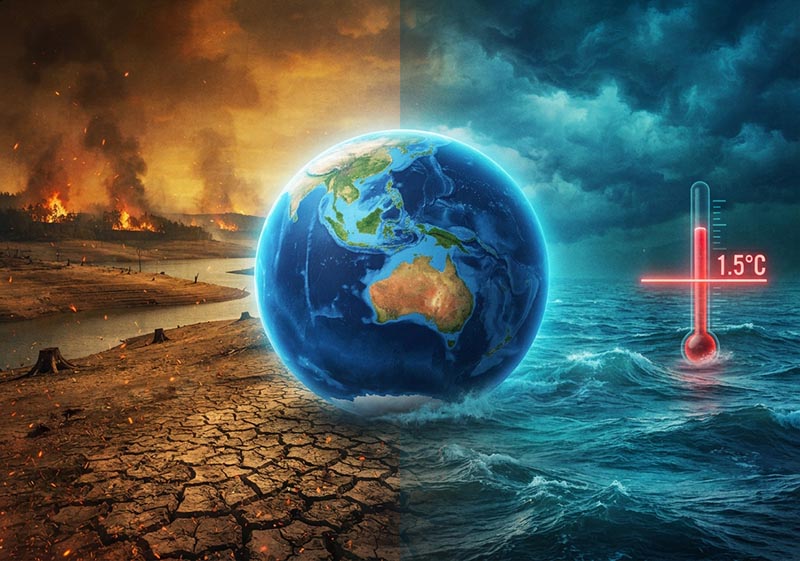
This year, the world experienced a preview of that reality as global temperatures breached the 1.5-degree mark for several months, triggering severe heat waves, wildfires, and flash floods. With a super El Niño unfolding, next year could be even worse. As one climate expert noted, this El Niño acts as a time machine to the 2030s, revealing our future if we fail to radically cut carbon emissions
18 November 2026
ALAN HAYES
FOR a decade, "Keep 1.5 Alive" served as the climate movement's unifying slogan, reflecting the core ambition of the 2015 Paris Agreement. Now, just 11 years later, that target is effectively dead. Without far more drastic cuts to greenhouse gases than humanity has managed so far, scientists project the planet will likely warm by at least 2.6 degrees Celsius by the end of the century.
At the COP31 United Nations climate summit in Antalya, Turkey, diplomats who long championed the 1.5-degree goal are speaking with stark honesty. "The world has no chance of holding to 1.5 degrees," said Chris Bowen, Australia’s Minister for Climate Change and Energy, who is leading negotiations at the summit.
The world now faces the severe consequences scientists have warned about for years. Crossing the 1.5-degree threshold means a profoundly more dangerous planet, marked by more frequent extreme heat, more destructive storms, and rising sea levels—with developing nations bearing the heaviest burden.
That grim reality is already unfolding. In recent months, wildfires have raged from Canada to Indonesia, a glacier collapse in Nepal killed thousands and wiped out entire towns, floods and mudslides devastated Brazil, and summer heat waves across Europe claimed an estimated 50,000 lives. If warming continues unchecked, scientists warn the planet could cross irreversible tipping points, including the thawing of Arctic permafrost, the rapid die-off of rainforests, and the slowdown of a vital Atlantic Ocean current.
The 1.5-degree target was always ambitious. Meeting it required wealthy nations to make sweeping, economically disruptive changes—an effort ultimately stalled by high costs, political resistance, and inertia. This failure has sparked a major debate at the climate talks over whether to establish a new benchmark.
"We don’t think that there’s a new target," said Ilana Seid, Palau’s ambassador to the United Nations. "We still have a Paris Agreement target of 1.5, and so we are still continuing to say that’s the target."
Rachel Cleetus, director of the climate program at the Union of Concerned Scientists, also cautioned against setting a new goal, arguing that humanity must confront the reality of having crossed the line. "I don’t think it’s a question of replacing 1.5," she said. "There is no new number. We are now in the unsafe zone." Leaders have similarly rejected resetting the target to 2°C or 2.5°C, warning that moving the goalposts creates a slippery slope that undermines real progress.
A Temporary Breach?
While acknowledging they have missed the mark, world leaders maintain that returning to 1.5 degrees of warming remains possible. United Nations Secretary-General António Guterres urged nations to redouble their efforts to cut emissions and eventually turn down Earth’s thermostat. "The truth is that we have the power to determine how high, how long and how devastating that overshoot will be," he said. "We have the power to make sure the overshoot is a temporary breach, not a permanent sentence."
So far, the 1.5-degree threshold has only been breached for a few months, yet global emissions remain near record highs. Despite the rapid growth of clean energy, the world is projected to rely on fossil fuels for decades. Simply fulfilling the original Paris pledges will no longer be enough to pull temperatures back down. Reversing the trend will require drastic cuts to coal, oil, and gas—and potentially more radical interventions.
Because cutting emissions has proven so difficult, some scientists and environmentalists are turning to geoengineering proposals. These range from large-scale carbon capture and storage to solar radiation management, which involves injecting particles into the stratosphere to reflect sunlight away from the Earth.
"Overshoot must be kept as small and short as possible, and be rapidly reversed," said Hilda Heine, president of the Marshall Islands, a low-lying nation acutely threatened by rising seas. "We have fallen short of the emissions reductions needed to stay under 1.5. We must rewrite the future."





SUBSCRIBE FOR FREE to the Grapevine News Online and to the monthly e-book edition of the Grapevine Community Weekly. Our online news platform and monthly newspaper is about real local news and events. We will not spam you or share your details with third parties.
