






Wall Street’s AI reckoning
reaches the Central Coast
When artificial intelligence giant Anthropic rang the opening bell on New York’s Nasdaq exchange last Thursday, traders from Martin Place to Manhattan hoped the record-breaking float would steady a rattling global technology sector. Instead, the turbulent two-day debut—which saw the Claude chatbot maker erase nearly all its early gains amid a fierce global tech sell-off—has sent shockwaves through the Australian sharemarket and cast a sharp financial spotlight on the booming data centre industry right here on the Central Coast.
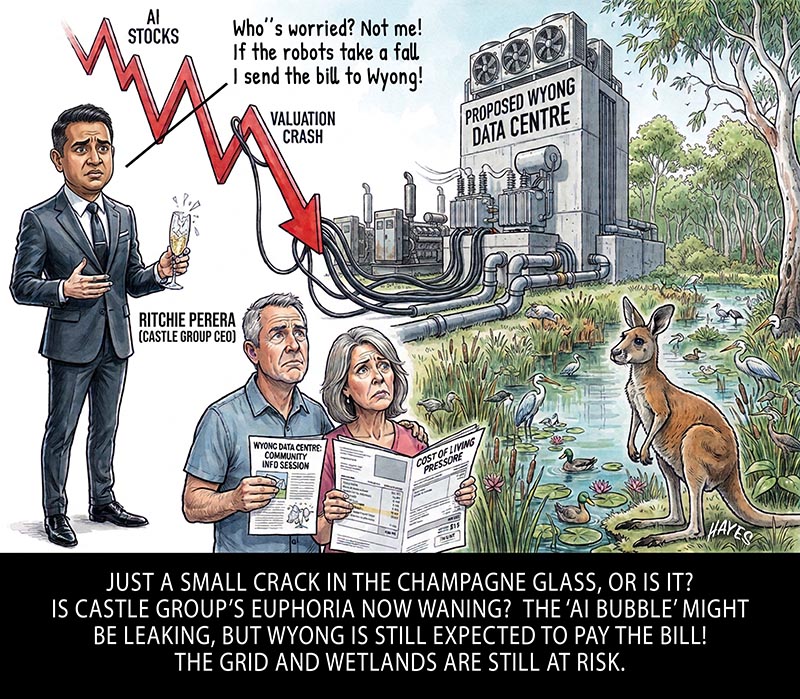
For residents in Wyong and the surrounding suburbs, the link between a multibillion-dollar Wall Street listing and local planning debates is suddenly tangible. Just days before Anthropic’s shares stumbled in New York, Castle Group hosted community briefing sessions at Warnervale Community Hall over its proposed 100-megawatt data centre in the North Wyong Industrial and Enterprise Precinct. Now, as global investors begin questioning the staggering cost of building the physical infrastructure behind the AI boom, local observers, environmental advocates, and economic analysts are asking what the market shift means for the future of Australia’s digital infrastructure pipeline.
25 November 2026
ALAN HAYES
ON paper, Anthropic’s initial public offering (IPO) on Thursday, 19 November, was a historic triumph. Priced at US$83 per share—well above its initial target range—the listing raised more than US$81 billion in public capital alongside tens of billions in private placements, cementing its place as the largest stock market debut in history. When trading opened, shares surged 34 per cent to US$111.50 and briefly peaked at US$115, giving the San Francisco-based company an implied valuation nearing US$2 trillion.
Yet the euphoria proved fleeting. By Thursday’s close, the stock had surrendered half its intraday rally to finish at US$97.17. On Friday, selling intensified across global exchanges. Anthropic tumbled roughly 9 per cent to close below US$89—hovering perilously close to its US$83 issue price—while chipmaking titan Nvidia plunged 14 per cent and the tech-heavy Nasdaq Composite wiped out all of its gains for 2026.
Market strategists say the sell-off reflects a fundamental shift in how Wall Street views the economics of artificial intelligence. Investors were rattled by disclosures showing that while Anthropic generated US$17 billion in quarterly revenue, it continues to post steep operating losses and has committed to spending an eye-watering US$900 billion on computing power and data centre infrastructure over the coming years.
Simultaneously, bond analysts warned that Anthropic’s debt could be rated below investment grade, raising doubts about how AI firms will finance the estimated US$10 trillion global build-out of digital infrastructure.
Ripple effects across the Australian economy
In Australia, the fallout from Wall Street’s AI reassessment was immediate. On Friday, 20 November, the benchmark S&P/ASX 200 dropped 1.6 per cent, wiping out its 2026 calendar-year gains as all 11 market sectors closed in the red. When local trading resumed on Monday morning, 23 November, the index opened down another 0.57 per cent at 8,543 points as weakness in financials, energy, and tech-adjacent stocks persisted.
For Australian superannuation funds, retail investors, and infrastructure developers, the correction carries two major implications:
- Tighter Capital for Digital Infrastructure: Over the past two years, Australian pension funds and private equity firms have poured billions into domestic data centre operators, betting on insatiable demand from US AI labs. With credit markets growing wary of circular financing deals and massive capital expenditure commitments, lenders are expected to demand stricter financial guarantees and clearer paths to profitability before backing new hyperscale facilities.
- Grid and Energy Scrutiny: Australia’s energy market operators and state governments have spent 2026 grappling with how to integrate power-hungry AI facilities into an already stretched electricity grid without driving up household power bills. A cooling in speculative AI valuations gives regulators and energy planners breathing room to scrutinise whether projected electricity demand from proposed facilities will actually materialise—or if some projects risk becoming under-utilised assets.
The battle over North Wyong’s proposed data centre
Nowhere is that tension between global tech ambition and local reality more visible than in the northern suburbs of the Central Coast.
Earlier this month, on 6 November, the NSW Department of Planning, Housing and Infrastructure issued Secretary’s Environmental Assessment Requirements (SEARs) for Castle Group’s proposed Lucca Road Data Centre (Application SSD-148199991), advancing the project through the State Significant Development pathway. Spanning industrial-zoned land at Lucca Road and Pavitt Crescent, the two-storey facility is designed to deliver roughly 96 to 100 megawatts of IT load capacity—enough electricity to power tens of thousands of homes—drawing power from the nearby Wyong Zone Substation. Let's not also forget the additional 54 megawatts of electricity required to power the cooling, electrical distribution, and building support systems needed to keep the facility running, twenty-four hours a day seven days a week.
Castle Group, a diversified Sydney-based developer active in property, battery energy storage systems, and digital infrastructure, has pitched the project as a major economic catalyst for the Central Coast. To address resource concerns, the developer has proposed a hybrid cooling system aimed at reducing reliance on town mains water.
However, the proposal has sparked fierce pushback from Central Coast residents, conservationists, and political representatives. Following Castle Group’s community drop-in sessions at Warnervale on 17 November, local opposition has coalesced around three primary concerns:
- Environmental Impact on Porters Creek Wetland: Critics warn that the North Wyong site sits precariously close to the ecologically sensitive Porters Creek Wetland. Local petitions and environmental groups point to scoping documents noting dozens of listed threatened and migratory species in the broader area, raising alarms over stormwater runoff, noise, vibration, and light pollution.
- Power Grid Strain and Electricity Bills: With a roughly 150-megawatt continuous power draw, residents fear the facility will place heavy strain on local transmission infrastructure and contribute to upward pressure on household energy costs across the Coast.
- Limited Long-Term Local Return: Opponents, including the Central Coast Greens, have argued that hyper-scale data centres consume vast amounts of land, water, and electricity while generating relatively few permanent jobs once construction wraps up—acting, in their words, as resource-heavy outposts built primarily to serve overseas tech giants
What comes next for Wyong?
Anthropic’s rocky debut on the Nasdaq does not mean the global demand for cloud computing or artificial intelligence is disappearing overnight. Even after Friday’s sell-off, Anthropic commands a market valuation well above US$1 trillion and holds nearly US$100 billion in cash to fund its immediate computing needs.
Yet for Castle Group and the NSW planning authorities assessing the Lucca Road proposal, the events of the past week underscore that the "build at any cost" phase of the AI boom is facing a stern reality check. As Castle Group prepares its comprehensive Environmental Impact Statement—which must address biodiversity, bushfire risk, traffic, water efficiency, and energy servicing under the newly issued SEARs—Central Coast residents will have formal opportunities to lodge submissions.
Whether Wall Street’s sudden caution slows down capital flowing into regional Australian data centres remains to be seen. For Wyong locals considering the cranes, power lines, and wetlands around Lucca Road, the message from New York’s trading floors is clear: the financial foundations of the AI boom are being tested, and Central Coast communities are demanding that the sensitive environment next to the proposed data centre comes first and is protected from the machinations of making the rich even richer.





SUBSCRIBE FOR FREE to the Grapevine News Online and to the monthly e-book edition of the Grapevine Community Weekly. Our online news platform and monthly newspaper is about real local news and events. We will not spam you or share your details with third parties.
