






And the money keeps rolling in
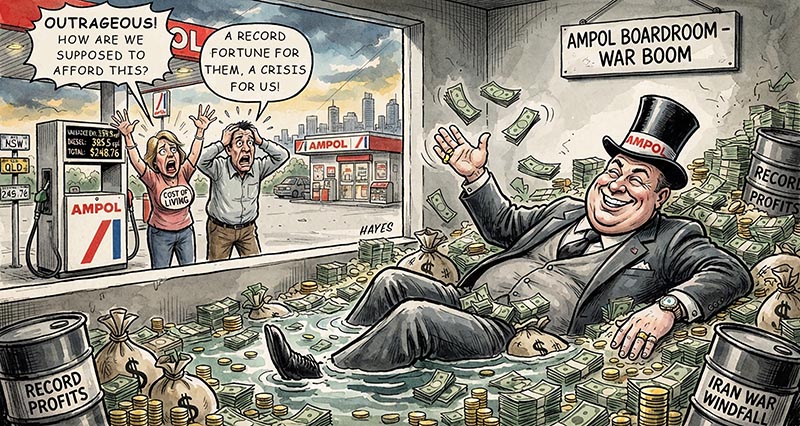
As Ampol war profits surge by 376 percent the increasing price of fuel is pushing Australians further into the red, leaving them under the pump at the bowser, and making impossible choices between paying for fuel or the rent.
Ampol Limited has shattered Australian corporate earnings records, delivering a historic A$1.36 billion half-year statutory net profit fuelLed directly by severe global oil supply shocks. The unprecedented windfall, which reverses a A$25.3 million loss from the same period last year, has triggered an explosive nationwide debate over corporate war-profiteering, cost-of-living pressures, and demands for an immediate federal windfall tax.
14 October 2026
ALAN HAYES
ANTHONY ALBANESE was the first leader to back the US-Israeli war on Iran. Now he must decide if wants to shield Australians from its devastating impacts or shield the skyrocketing war profits of fossil fuel giants.
Why? Because the financial explosion of profit stems directly from critical energy infrastructure bottlenecks on the other side of the globe. Following the eruption of conflict and the subsequent partial closure of the Strait of Hormuz—the world’s most vital maritime oil transit choke point—global energy supply chains fractured.
As physical crude shipments stalled and maritime insurance premiums spiked, international product availability cratered. For Ampol, which operates the Lytton oil refinery in Brisbane, this international crisis translated into immediate, astronomical domestic margins.
While crude oil prices steadily rose, the true goldmine lay in refining margins—the dollar spread between the raw cost of unrefined crude and the market price of processed petrol and diesel.
- Tripled Margins: Ampol's Lytton refinery margin skyrocketed to a historic average of US$28.26 per barrel, a massive surge from the US$7.44 average recorded just twelve months prior.
- The March Peak: At the absolute height of the initial Strait of Hormuz naval bottlenecks, monthly refining margins reached an unprecedented US$56.14 per barrel.
- Divisional Growth: Fueled by these figures, the Earnings Before Interest and Taxes (EBIT) for Ampol’s underlying Fuels and Infrastructure division jumped more than nine-fold to A$1.13 billion.
On an underlying Replacement Cost Operating Profit (RCOP) basis—the metric most closely watched by equity analysts as it strips out volatile inventory fluctuations—Ampol's net profit exploded by over 376%, landing at A$857.2 million. Group EBITDA also lifted by 152%, topping out at A$1.64 billion.
Shareholder bonanza vs. bowser pain
The immediate beneficiaries of this historic surge are Ampol’s institutional and retail investors. Backed by a vast sea of newly accumulated cash, Ampol management authorised a massive interim dividend payout of 185 cents per share, up from just 40 cents in the prior period.
However, outside the glass walls of the corporate boardroom, everyday Australian motorists are experiencing a vastly different reality. The very same supply constraints that drove Ampol's record quarterly results pushed domestic pump prices past historic highs across major capital cities.
In working-class outer suburbs and regional hubs—where public transport alternatives remain severely limited—families are reporting unprecedented financial distress. For many households, the cost of filling a standard family sedan has risen past A$150 per tank, swallowing an ever-growing share of stagnant disposable incomes.
Consumer advocacy groups have warned that high fuel prices are creating a brutal cascading effect across the entire Australian economy. Independent freight operators and grocery distribution networks are actively passing soaring diesel costs down the supply chain, artificially inflating the baseline prices of everyday essentials like bread, milk, and fresh produce.
Leader of the Australian Greens, David Shoebridge said “Everyday people didn’t start this war. Families struggling to pay their bills didn’t create this fuel crisis. Yet they are being forced to wear the cost while corporations make billions off chaos and war.
“Meanwhile Anthony Albanese is protecting those very corporations making a killing from the fuel crisis.
“Labor keeps telling people the time is not right to tax these corporations. If the right time isn’t now, when multinational corporations bank billions at the expense of families skipping essentials to afford to get to work, then when exactly is the right time?
“The Greens want a windfall tax on war profits flowing from the energy crisis and a minimum 25 percent tax on gas exports to fund cost-of-living relief and essential services.
“It’s time for an Australian government to side with the Australian people, not a bunch of multi-national corporate donors.”
Political backlash and windfall tax demands
The jarring contrast between record-breaking multi-billion-dollar corporate profits and widespread household financial hardship has ignited a political firestorm in Canberra.
The Australian Greens have seized on the financial filing to launch an aggressive, highly coordinated public campaign demanding structural legislative intervention. The minor party is formally calling on the Federal Labor Government to institute an emergency windfall profit tax explicitly targeting fossil fuel giants and domestic energy refiners.
"While millions of Australians skip meals and delay healthcare because they can't afford to put petrol in their cars, corporate executives are making an absolute killing off global chaos and war," said the Greens' treasury spokesperson in a press conference outside Parliament House. "This isn't the result of superior corporate innovation or hard work; it is unearned revenue derived directly from suffering. That money belongs back in the pockets of everyday Australians through direct cost-of-living relief."
The federal opposition has levelled its own criticisms, pointing to the figures as structural evidence of a broader, systemic failure in national energy security. They argue that the current crisis highlights Australia's dangerous vulnerability to international supply shocks, pointing to the rapid closures of domestic refineries over the past decade which have left the nation heavily reliant on fragile international trade routes.
The Federal Government finds itself walking an incredibly narrow economic tightrope.
Treasury officials have expressed deep wariness regarding sudden, aggressive shifts in the corporate tax architecture, warning that unexpected windfall taxes could severely chill critical foreign investment and jeopardise long-term commercial outlays needed for Australia's broader green energy transition.
Looking ahead: an uncertain horizon
In presentations to market analysts and institutional shareholders, Ampol's executive leadership team has maintained a notably cautious, defensive tone, actively downplaying expectations that these extraordinary returns represent a permanent state of affairs.
"These results are the direct consequence of historic, unprecedented international market disruptions and severe global product supply tightness," the Chief Executive stated during the earnings call. "While our refining infrastructure has performed remarkably well under intense operational pressure to keep Australia moving, we fully expect regional refining margins to eventually normalise as global shipping routes adjust and alternative supply lines stabilise."
Whether margins cool in the coming quarters or remain highly volatile, the political and cultural fallout from this earnings season is bound to linger. With a federal election approaching, the conversation around corporate accountability, national fuel self-sufficiency, and equitable taxation is only just beginning. For now, Ampol remains both an incredibly lucrative safe haven for investors and a primary lightning rod for a public deeply fatigued by a relentless cost-of-living crisis.
The Australian Greens' solution to the energy crisis focuses on breaking what they describe as "textbook corporate capture" by heavily taxing multinational fossil fuel and fuel refining giants. Led by resources and deputy leader Senator Steph Hodgins-May, the Greens argue that regular citizens should not be forced into poverty by a war-driven crisis they did not create.
Steph Hodgins-May said “Australians are being forced to pay the price for a crisis they didn’t create and a war they don’t want.
“Corporations like Ampol are making billions while families are struggling to afford to fill up the tank. These companies have the money to bankroll Labor and lobby against the tax changes that would actually help households.
“This is textbook corporate capture. It’s why Labor has ignored the huge groundswell of support for a minimum 25 per cent tax on gas exports, and why it’s refusing to tax the windfall profits fossil fuel giants are making off this war.
“Labor needs to finally decide whose side it’s on. The fossil fuel corporations cashing in on blood-soaked profits, or the Australians left picking up the bill.”
To counter the record windfalls of companies like Ampol Limited and international oil and gas exporters, the Greens have introduced a multi-pronged legislative and economic framework.
The three pillars of the Greens' plan
An Immediate "War Profits" Windfall Tax:
The Greens are demanding an emergency windfall tax targeted specifically at corporate super-profits stemming from the Middle East energy crisis and the Strait of Hormuz shipping disruptions.
- The Mechanism: This functions alongside their broader economic policy, which proposes a permanent 40% excess profits tax on any large corporation generating a turnover exceeding A$100 million.
- The Rule: The tax would apply to net revenue earned above a baseline "fair return" (calculated using shareholder equity, a standard 5% buffer, and the long-term government bond rate).
A Minimum 25% Gas and Energy Export Tax:
As international fuel and liquified natural gas (LNG) prices have surged due to the US-Iran conflict, the Greens are aggressively forcing Senate votes to introduce a flat minimum 25% export tax on energy shipments.
- The party notes that multinational gas exporters are projected to pocket an unearned A$18 billion windfall purely from war-induced price hikes. The export levy aims to trap a substantial portion of those offshore-bound profits locally.
Closing the PRRT Loophole:
The party plans too heavily reform the Petroleum Resource Rent Tax (PRRT). Under current rules, fossil fuel companies avoid billions in taxes by burning through a historical stockpile of "deductible tax credits". The Greens want to immediately dismantle the use of these accumulated credits, forcing companies to pay resource rent taxes instantly during price surges.
Where would the tax money go?
The Greens state that the billions raised from these war-profit taxes would not sit in government coffers but would instead be immediately redirected into direct cost-of-living relief and public funding.
Relief target:
- Energy Bills - Direct government subsidies to lower electricity and gas bills for everyday households.
- Public Services - Funneling billions into underfunded public health, childcare, and local infrastructure.
- Bowser Relief - Subsidising transit options or providing structural relief to outer-suburban families currently forced to choose between fuel and rent.
Current political status
The continuous pressure—backed by independent crossbench MPs like Allegra Spender and Senator David Pocock—has significantly disrupted federal politics.
In response to this growing alliance, Prime Minister Anthony Albanese recently directed the Australian Treasury to officially model a windfall profits tax and alternative fuel levy scenarios.
While the Federal Labor Government has hesitated to fully legislate the Greens' 40% model over fears of chilling international investment, the Greens maintain that if a multi-billion-dollar war boom isn't the right time to protect struggling families, "then when exactly is?".



.jpg?crc=4257584689)


_web.jpg?crc=282450513)


SUBSCRIBE FOR FREE to the Grapevine News Online and to the monthly e-book edition of the Grapevine Community Weekly. Our online news platform and monthly newspaper is about real local news and events. We will not spam you or share your details with third parties.
