





Coastal lands
protection scheme betrayed
In a dramatic confrontation between local governance and statutory planning law, an attempt by Central Coast Council to classify highly sensitive, State-acquired coastal land as "Operational" has been exposed as an unlawful overreach. Documents and ministerial interventions have confirmed that the Council’s recent controversial vote directly breached Section 31(3) of the New South Wales Local Government Act 1993, invalidating a push by bureaucrats to strip away public protections from environmental lots at Avoca Beach and Wamberal.
The fallout has sent shockwaves through the region's civic administration, pitting an active community against senior Council staff and the eight Councillors who voted the measure through. The intervention by the NSW Department of Planning, Housing and Infrastructure (DPHI) marks a significant victory for local residents who argued that the local government was actively attempting to pave the way for commercial exploitation of lands explicitly set aside for environmental preservation.
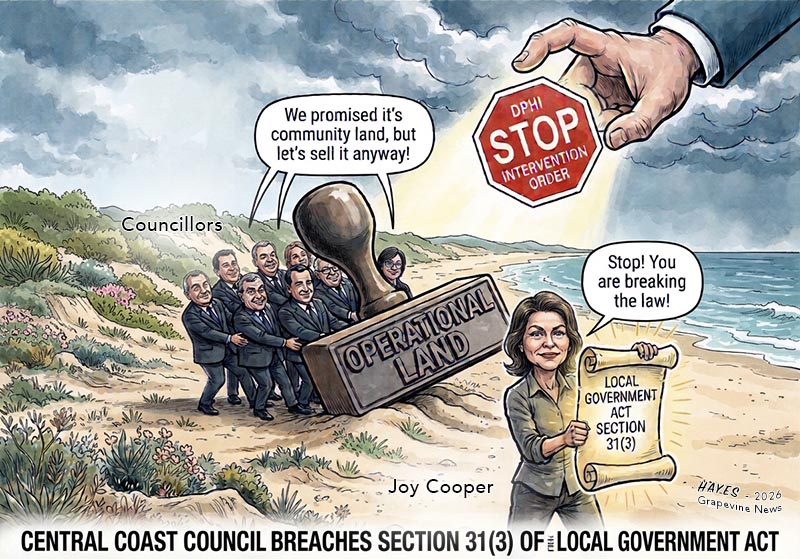
Central Coast resident and environmentalist Joy Cooper was a 'voice of reason', ensuring that community land, protected by Section 31(3) of the Local Government Act 1993, could not be sold off by Council.
4 November 2026
ALAN HAYES
THE Coastal Lands Protection Scheme crisis centres on several parcels of pristine coastal land, including a prominent lot at 7 Carnegie Drive in Avoca Beach alongside critically positioned beachfront lots at Wamberal. These parcels were originally acquired by the NSW Government under the historic Coastal Lands Protection Scheme.
Initiated decades ago, the scheme was designed with a singular, unyielding objective: to rescue ecologically fragile foreshores, sand dunes, and coastal wildlife corridors from the relentless pressure of residential and commercial property markets. By bringing these properties into public ownership, successive state governments guaranteed they would remain permanent environmental buffers, held in trust for the public.
However, when administrative control of these properties was transferred from the State’s Office of Strategic Lands to the Central Coast Council, a quiet bureaucratic maneuvering began behind closed doors.
Under the New South Wales Local Government Act 1993, public land managed by local councils must be categorised into one of two classifications: "Community" or "Operational." Community land consists of parks, reserves, and conservation areas. It cannot be sold, exchanged, or leased for private commercial purposes for longer than a highly restricted period. Operational land, by stark contrast, is treated like ordinary commercial real estate. It can be sold off to developers, leased out to corporations, or built upon with minimal public oversight.
The broken promise
Evidence has revealed that Central Coast Council was fully aware of the restricted nature of the parcels before attempting to change their status. On 19 January 2026, Council administration formally wrote to the State’s Office of Strategic Lands. In that correspondence, the Council explicitly pledged that upon receiving the titles for the Wamberal and Avoca Beach lots, the land would be safely classified as Community land, preserving its environmental status.
Yet, just eight months later, that written commitment was discarded. On 22 September 2026, Council staff tabled a comprehensive report before the newly elected chamber. Despite the explicit statutory boundaries and the Council's own prior assurances to the State, the staff report recommended that the transferred parcels instead be classified as Operational land.
The justification offered by staff focused on administrative flexibility and asset management, a common corporate rationale used within amalgamated councils. But to local conservationists and legal watchdogs, the recommendation was a transparent attempt to bypass public restrictions.
When the matter went to a vote, eight local Councillors voted en bloc to accept the staff recommendation. By doing so, the majority chamber attempted to illegally re-categorise the coastal sanctuaries into disposable council assets, disregarding the explicit public purpose for which the land was originally acquired.
The warning ignored
The Council’s political executive did not execute this maneuver without warning. During the public forum preceding the vote, prominent local advocate and former councillor Joy Cooper took to the lectern to deliver a blistering critique of the staff report.
Cooper formally warned the chamber that the resolution before them was structurally illegal. She stated that the council was walking directly into a statutory trap, noting that local governments do not possess the unilateral authority to wipe away state-mandated environmental protections via a standard council resolution.
The chamber's leadership brushed the warnings aside, relying on internal staff advice to push the vote through. The eight Councillors who voted in favour of the Operational classification effectively ignored the community's legal objections, gambling that the state government would not audit the transaction.
The anatomy of the breach: Section 31(3)
The legal reality caught up with the Council faster than anticipated. Section 31(3) of the Local Government Act 1993 serves as an explicit statutory lock against the commercialisation of public assets. The section explicitly mandates that if a council acquires land from a State government department, agency, or statutory body, and that land was subject to a prior restriction, dedicated for a public reserve, or acquired for an environmental purpose, the Council cannot simply declare it "Operational" by a standard resolution.
The law is designed precisely to stop local councils from acting as real estate liquidators for state-acquired environmental buffers. Because the DPHI land was bought using dedicated funds to secure coastal protection, its DNA is legally bound to public preservation.
Following a barrage of formal complaints from the community, DPHI senior planning officials launched an immediate review into the Central Coast Council’s September resolution. The independent ministerial investigation concluded swiftly: the Council's resolution was a direct, unambiguous breach of Section 31(3).
DPHI issued formal advice to the Council executive, confirming that the local government’s attempt to brand the Avoca Beach and Wamberal lots as "Operational" was legally invalid. The state planning department's ruling effectively nullified the council vote, leaving the administration exposed and forcing an embarrassing retreat.
A voice of reason
At the supplementary Council meeting on 27 October, the eight councillors, who voted in favour of community land becoming operational, changed their mind. Joy Cooper, who fought diligently against Council's decision, said at the meeting: "I take no pleasure in saying I told you so (except to my husband), however, when the community points Council directly to the governing legislation, it pays to read it before voting.
"I welcome the recommendation to rescind the previous 8–7 resolution that sought to classify these foreshore assets as Operational Land. When I addressed this chamber on 22 September, I raised this exact issue with Council: that resolving to make State-acquired NSW Department of Planning, Housing and Infrastructure (DPHI) land Operational breached Section 31(3) of the Local Government Act. DPHI’s advice has proven my warning entirely correct.
"I am aware that on 19 January 2026, Council wrote to the Office of Strategic Lands explicitly advising that the Wamberal lots would be classified as Community Land.
"If Council promised the State in January that these lots would be Community Land, why did staff put forward a report in September recommending Operational status? And why did eight Councillors vote to breach Council's own written commitment and the core vision of the Scheme?
"The official vision of the Coastal Lands Protection Scheme is “to protect the special qualities of the NSW coast in their natural state for current and future generations.
"DPHI has made it clear: Council cannot dispose of this land, and ownership reverts to the State at nil value if Council fails in its duties.
"Let us learn from Central Coast Council’s time-wasting (exercise), honour your January commitment, and treat our public coastal reserves with the legal respect, rationality, fairness, honesty, integrity, generational equity, and environmental care they deserve."
A pattern of governance failure
For many Central Coast residents, this latest legal breach is symptomatic of a deeper, systemic issue within the Council’s planning and asset departments. Having only recently emerged from a prolonged period of administration, following a severe financial collapse in 2020, the community expected the newly restored democratic chamber to operate with absolute transparency and strict legal compliance.
Instead, the attempt to transition coastal protection land into a sellable category has reignited fears of a return to the unchecked developer-driven agendas that have historically plagued the region.
"This wasn't an oversight; it was a deliberate strategy to unlock protected coastal land," said an Avoca Beach resident who requested anonymity. "If community members hadn't dug into the legislation and exposed Section 31(3), these lots could have been quietly packaged up and sold off to the highest bidder under the guise of 'operational efficiency.' We cannot trust the staff or the councillors who blindly voted for this."
The focus now turns to accountability. Questions are being raised regarding who within the Council's senior planning staff drafted the September report, and why internal legal counsel failed to identify a blatant contradiction with the Local Government Act.
Next steps and rescission
With the DPHI ruling now firmly on the table, the Central Coast Council has no choice but to undo the unlawful resolution. Council sources indicate that a formal rescission motion or an overriding staff correction will have to be tabled at the upcoming ordinary meeting to officially categorise the land as Community space, bringing the Council back into alignment with state law.
Local community groups, however, are not pacified by the state's intervention alone. Activists are currently preparing demands for an independent audit of all land transfers processed by the Council over the last three years to ensure no other State-acquired environmental lots have been quietly slipped into the Operational Asset Register.
The 22 September vote will likely stand as a defining marker for the current council term—a stark reminder that while local bureaucrats hold significant administrative power, they remain entirely subordinate to the statutory laws of New South Wales and the vigilant oversight of the community they are elected to serve.





SUBSCRIBE FOR FREE to the Grapevine News Online and to the monthly e-book edition of the Grapevine Community Weekly. Our online news platform and monthly newspaper is about real local news and events. We will not spam you or share your details with third parties.
