






Data centre proposal meets
wetland conservation fears
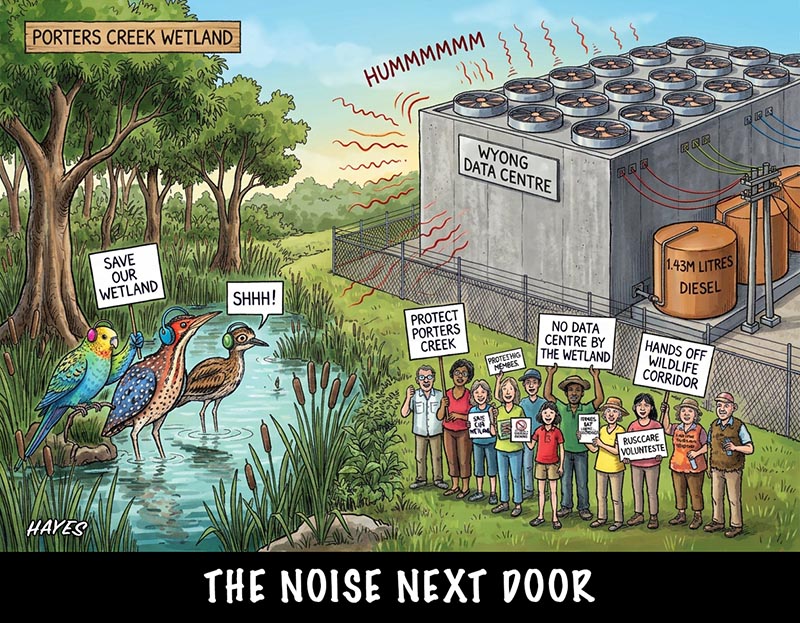
A fierce debate over the future of the Central Coast’s industrial growth and its fragile coastal ecosystems has reached a boiling point in North Wyong yesterday, as residents and conservationists rallied outside Warnervale Community Hall to oppose a proposed $1.5 billion data centre.
The facility, earmarked for a 12.43-hectare parcel of land at 30 Lucca Road, is set to be the largest digital infrastructure project on the Central Coast. Submitted to the NSW Department of Planning, Housing and Infrastructure as a State Significant Development (SSD) by proponent Castle Group, the two-storey, 96-megawatt facility is designed to operate 24 hours a day, seven days a week.
However, the site’s location within the North Wyong Industrial and Enterprise Precinct places it directly alongside the lower floodplain of Porters Creek Wetland and adjacent wildlife corridors—sparking alarm among local environmentalists, bushcare volunteers, and nearby residents in Hamlyn Terrace, Wadalba, and Warnervale.
When Grapevine publisher Alan Hayes questioned Castle Group (the proponent) General Manager, Strategy and Capital and Digital Infrastructure, about the impact of noise on endangered and critically endangered bird species that nest and forage in the wetlands, all he could say was that they would “attempt to reduce the noise”. There were no guarantees that their facility would not create an unacceptable noise-level risk for the wildlife.
Porters Creek Wetlands is the largest remaining freshwater wetland on the NSW Central Coast, covering approximately 500 hectares (5 square kilometres) across the suburbs of Warnervale and Wyong. It serves as a critical ecological filter for stormwater before it enters the Wyong River and Tuggerah Lakes. The site contains five Endangered Ecological Communities listed under the Biodiversity Conservation Act 2016. Its habitats transition from permanent reed, sedge, and rushlands into surrounding Melaleuca and Eucalypt swamp forests.
18 November 2026
ALAN HAYES
AS Castle Group hosted its first in-person community consultation sessions at Warnervale Community Hall yesterday, opponents had already organised a sidewalk protest outside the venue. The demonstration follows weeks of mounting online pressure, including a Change.org petition calling for a pause and deeper scrutiny of the project, which has rapidly gathered signatures across the region.
For many locals, the crux of the issue is not just the scale of the industrial complex, but its proximity to one of the Central Coast’s most vital freshwater wetland systems. Porters Creek Wetland acts as a natural kidney for the Tuggerah Lakes catchment, filtering stormwater runoff and providing critical habitat for a suite of threatened flora and fauna.
"You cannot drop an industrial facility of this magnitude right on the doorstep of a sensitive wetland floodplain and expect zero fallout," said one local environmental advocate. "We have spent decades rehabilitating these corridors, and now we are looking at 24-hour noise, massive heat output, and over a million litres of stored diesel right next door."
Porters Creek Wetland is far more than a scenic patch of bushland; it is an ecological lifeline. Preliminary assessments linked to the development proposal acknowledge the richness of the surrounding environment, noting the presence of 53 listed threatened species and 14 listed migratory species in the broader area.
Among the most vulnerable residents is the Australasian Bittern (Botaurus poiciloptilus). Listed as endangered in New South Wales and nationally, this secretive, stocky heron relies on dense, undisturbed tall reeds and spike-rushes to forage for frogs, fish, and aquatic invertebrates. Because bitterns are notoriously shy and sensitive to environmental changes, even minor disruptions to water levels or surrounding noise can drive them from a breeding habitat permanently.
Equally at risk is the Swift Parrot (Lathamus discolor), a critically endangered migratory species with an estimated wild population of fewer than 750 individuals. Each winter, Swift Parrots migrate from their breeding grounds in Tasmania to mainland Australia, relying heavily on the winter-flowering Swamp Mahogany (Eucalyptus robusta) forests that fringe Porters Creek Wetland. Alongside migratory shorebirds, raptors, and woodland species, these birds depend on the wetland’s delicate ecological balance to survive.
Other endangered birds are:
- Regent Honeyeater (Anthochaera phrygia). Listed as Critically Endangered, with fewer than 500 individuals estimated in the wild. It utilises the Central Coast's swamp forests and coastal woodlands as seasonal foraging habitat.
- Bush Stone-curlew (Burhinus grallarius). Listed as Endangered in NSW, this ground-dwelling bird is recorded in the Wyong coastal floodplain and swamp forest vegetation communities. It is particularly vulnerable to habitat fragmentation and nearby industrial activity.
- Migratory Shorebirds (e.g., Curlew Sandpiper & Latham's Snipe). Porters Creek Wetland and the connected Tuggerah Lakes system support vulnerable and critically endangered migratory birds such as the Curlew Sandpiper (Calidris ferruginea, Critically Endangered) and Latham's Snipe (Gallinago hardwickii).
Stormwater, concrete, and water quality
The most immediate physical concern raised by environmental scientists involves the sheer scale of the proposed development’s footprint. Constructing a 96-megawatt data centre requires replacing acres of permeable soil and vegetation with vast expanses of concrete, roofing, and asphalt.
"Porters Creek Wetland acts like a giant sponge and kidney for the Central Coast, slowing down floodwaters and filtering pollutants before they enter Tuggerah Lake," explained one local environmental advocate. "When you pave over more than twelve hectares right next to the wetland’s northern and western interfaces, you dramatically alter how water enters that system."
During heavy East Coast rain events, vast quantities of stormwater will sheet rapidly off the industrial site rather than soaking naturally into the ground. This sudden influx of fast-moving runoff risks scouring fragile creek banks, smothering aquatic plant beds with sediment, and carrying urban pollutants—such as oils, heavy metals, and microplastics from hardstand areas and car parks—directly into the feeding grounds of wading birds and the Australasian Bittern. Furthermore, any alteration to the wetland’s natural wetting and drying cycles can disrupt the breeding triggers of frogs and aquatic insects that form the base of the wetland food chain.
The invisible threat: 24/7 noise and vibration
Unlike traditional warehouses or light industrial workshops that wind down at the end of the workday, a hyperscale data centre never sleeps. To prevent thousands of high-powered servers from overheating, these facilities rely on massive banks of industrial chillers, cooling towers, and ventilation fans running continuously around the clock. Additionally, rows of heavy-duty diesel backup generators require regular testing to ensure uninterrupted power.
Ecologists warn that this constant low-frequency mechanical hum and vibration can penetrate deep into adjacent bushland, creating an invisible barrier of acoustic pollution. Birds rely on intricate vocalisations to defend territories, attract mates, and warn flock members of approaching predators.
For species like the Australasian Bittern—whose deep, booming mating call travels across reedbeds during breeding season—persistent industrial background noise can mask communication and elevate stress hormones. Over time, chronic noise pollution forces sensitive wildlife to abandon prime foraging and nesting zones along the wetland’s edge, effectively shrinking the size of their usable habitat without a single bulldozer crossing the boundary line.
Artificial light and fragmented flyways
The round-the-clock nature of the Lucca Road facility also brings the threat of artificial light at night. High-intensity security lighting across a sprawling 12-hectare compound can spill over into the dark canopy of the neighbouring floodplain forest.
Artificial light disrupts the circadian rhythms of nocturnal and crepuscular wildlife, disorients migrating birds navigating by starlight, and alters predator-prey dynamics. Owls, night-herons, and roosting parrots can become confused or exposed to nocturnal predators when natural darkness is erased. Combined with the physical bulk of a towering two-storey structure sitting directly alongside open low-lying land, the facility threatens to fragment local flight corridors used by birds moving between coastal forests and inland feeding grounds.
A call for scrutiny
While Castle Group has stated that the Wyong Data Centre is still in its early planning and community engagement stages—and will undergo rigorous environmental assessments—community members remain deeply sceptical. Recent petitions calling on authorities to pause and scrutinise the project highlight widespread concern that current planning regulations around noise, vibration, water runoff, and light spill are ill-equipped to protect sensitive ecology from the unique pressures of modern hyperscale data centres.
As the Central Coast balances the push for economic investment and digital infrastructure against the preservation of its natural heritage, conservationists argue that location is everything.
"We aren't against technology or local jobs," a spokesperson for local wetland advocates said. "We are asking why a 24-hour industrial facility with massive energy and cooling demands needs to sit right against the fence line of an irreplaceable sanctuary. Once we compromise the health of Porters Creek Wetland, the Swift Parrots and bitterns won't get a second chance."
Grapevine publisher and environmental activist Alan Hayes said the Castle Group’s community consultation yesterday had the same eerie feeling when the gas and coal proponents first arrived. “Butter wouldn’t melt in their mouth propaganda. Too swami to be trusted,” he said.
“Their proposal doesn’t bring anything to the Central Coast. It was obvious they weren’t across the critically endangered birds and the sensitive nature of the wetlands. It’s all about money—nothing more, nothing less.”
With the NSW Department of Planning’s assessment process now underway, local residents and environmental groups are preparing to make their voices heard—determined to ensure that the digital future of Wyong does not come at the cost of silencing one of its oldest and rarest natural choruses.





SUBSCRIBE FOR FREE to the Grapevine News Online and to the monthly e-book edition of the Grapevine Community Weekly. Our online news platform and monthly newspaper is about real local news and events. We will not spam you or share your details with third parties.
