






High Court ruling
puts fossil fuel giants on notice
The High Court ruling last week was a landmark step that striped bare the government's excuses that they are not responsible for the emissions burned overseas. The High Court made it clear that 80 per cent of our coal and gas that is exported overseas is their responsibility.
The High Court delivered a historic, precedent-shattering ruling that reshapes the legal landscape for fossil fuel projects nationwide. The decision has effectively stripped the company of its 2022 approval to double the scale of its massive Mount Pleasant open-cut coal mine in the New South Wales Hunter Valley.
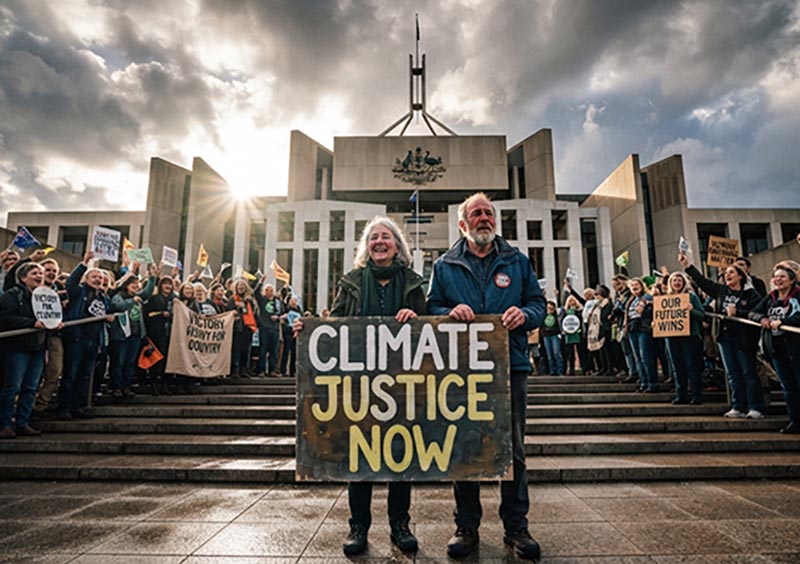
Wendy Wales and Tony Lonergan lauded for their historic grass-roots campaign.
14 October 2026
ALAN HAYES
IN ITS first-ever climate judgment, the High Court, in a 3–2 majority decision, dismissed an appeal by MACH Energy over the proposed expansion of the Mount Pleasant coal mine in the Hunter Valley, finding that planning authorities must consider the global climate impacts of a project's emissions and how to minimise damage.
The ruling puts fossil fuel companies and governments on notice as Australia continues to approve new coal and gas projects amidst Pacific pre-COP and ahead of COP31 where it was leading climate negotiations. Governments and fossil fuel companies are accountable for the climate damage caused by their projects.
The decision establishes a powerful legal truth: Australian planning authorities must legally and exhaustively account for Scope 3 emissions—the downstream pollution generated when exported coal, gas, or oil is burned overseas.
For decades, fossil fuel developers argued that because their products are consumed outside Australia's borders, the resulting greenhouse gases are a global problem rather than a domestic legal hurdle. The High Court has definitively closed that loophole. The ruling sends a clear signal to the
Greens Senator Steph Hodgins-May, Deputy Leader and assistant spokesperson for Climate Change & Energy said “In true form, the Prime Minister said he wanted the coal corporation to win this case, but today, despite his fealty, the local Hunter community has won.
“Congratulations to the two retired science teachers who spent four years challenging this massive fossil fuel company owned by a billionaire in a Virgin Island tax haven.
“The High Court backed the community in calling out the Labor government for continuing to ignore the climate consequences of fossil fuel projects. This ruling now makes that impossible.
“For too long, big coal and gas companies have tried to pretend that the emissions from their products are someone else’s problem once they leave Australian shores. They’re not.
“When Australian coal is burned overseas, the climate damage doesn’t magically disappear at the port. It comes back to communities here through worsening heat, drought, bushfires and floods.
“This judgment sends a clear message to governments and fossil fuel companies that the climate impacts of their projects cannot simply be ignored or pushed down the line.
“With the HVO expansion and Browse proposal currently on their desk, the Albanese Government should be paying close attention. The ICJ and now the High Court have made it clear - climate impacts must be considered in fossil fuel project assessments.
“The case shows that Australia’s national environmental laws are broken. Without a climate trigger, communities have to spend years in court to get climate impacts properly considered when the responsibility on government should be clear from the outset.
“You cannot claim to be serious about climate action, to lead climate negotiations at COP, all while continuing to approve new fossil fuel projects and pretending their emissions are someone else’s problem.
“The Greens will keep pushing to make the big fossil fuel corporations profiting from these projects accountable for the damage they are causing, and force Labor to take responsibility for the climate consequences of the projects it approves.”
The battle of Mount Pleasant
The legal saga began in 2022 when the NSW Independent Planning Commission (IPC) greenlit MACH Energy’s ambitious expansion plans for Mount Pleasant. The project aimed to extend the mine's operational lifespan from 2026 out to 2048, doubling extraction rates to a staggering 21 million tonnes of run-of-mine coal per year.
Had it proceeded unchecked, the expansion was projected to release an estimated 860 million tonnes of carbon dioxide equivalent over its lifetime. The vast majority of this would come from Scope 3 emissions generated by overseas power stations.
A small but determined grassroots community organisation, the Denman Aberdeen Muswellbrook Scone Healthy Environment Group (DAMS HEG), refused to accept the approval. Spearheaded by retired local science teachers Wendy Wales and Tony Lonergan, the group launched a relentless four-year legal campaign. Defended by the Environmental Defenders Office (EDO), DAMS HEG argued that the IPC had failed a fundamental duty: it did not properly weigh how those 860 million tonnes of global emissions would directly fuel localised climate disasters within NSW, such as catastrophic bushfires, prolonged droughts, and deadly heatwaves.
After a gruelling journey through the NSW Land and Environment Court and the Court of Appeal, the battle culminated on the steps of the High Court in Canberra. The resulting judgment represents the first time the High Court has ruled on the merits of a climate change-focused judicial review.
Dissecting the High Court’s judgment
The core of the High Court’s majority ruling focuses on the statutory obligations embedded within the NSW Environmental Planning and Assessment Act. The majority justices ruled that the IPC’s treatment of Scope 3 emissions was legally flawed and superficial. They determined that global emissions cannot be conceptually divorced from local environmental harm.
The court ruled that greenhouse gases do not respect geopolitical borders. Therefore, pumping hundreds of millions of tonnes of carbon into the atmosphere abroad directly harms the local environment in New South Wales by exacerbating the severity of climate change. By treating these emissions as an externalised, abstract factor rather than a direct threat to the NSW environment, the IPC failed its mandatory obligations under the law.
In contrast, the dissenting justices expressed concern over judicial overreach, arguing that greenhouse gas management and export policy should remain strictly within the purview of elected governments and executive planning bodies rather than the courts. However, the majority’s interpretation now stands as the definitive law of the land.
Seismic waves through the coal sector
The immediate consequence of the ruling is that the Mount Pleasant expansion approval is void. The case now returns to the NSW Land and Environment Court, which must determine the project's fate.
Legal experts suggest the mine faces two primary pathways, both of which severely threaten its commercial viability:
- Total Suspension: The court may completely halt the expansion, forcing operations to wind down as originally scheduled.
- Exorbitant Offset Mandates: The court could choose to allow modified operations only if MACH Energy completely offsets the project's entire emissions profile.
With carbon credit prices steadily climbing, forcing a developer to purchase offsets for 860 million tonnes of carbon introduces an astronomical financial burden. Industry analysts suggest that such a requirement would completely shatter the economic viability of the project, effectively killing it via the balance sheet.
Beyond Mount Pleasant, the ruling casts a long shadow over the broader Australian mining sector. According to environmental registries, there are currently 17 other coal proposals progressing through various stages of the NSW planning pipeline alone. Every single one of these projects must now be reassessed under the stringent new standard set by the High Court. Law firms specialising in resources have reportedly begun advising clients that their current environmental impact statements are legally vulnerable and require immediate, costly revisions.
A tipping point for climate litigation
Environmental and climate organisations across the globe have lauded the verdict as a historic milestone. Activists argue that the ruling bridges a long-standing disconnect in Australian climate policy, where domestic emissions are tightly regulated while the nation simultaneously remains one of the world's largest fossil fuel exporters.
"This is an extraordinary victory for frontline communities," said a spokesperson for Greenpeace Australia Pacific. "For years, coal giants have hidden behind the fiction that exported pollution isn't Australia's responsibility. The High Court has shattered that myth. This ruling aligns Australian law with scientific reality: carbon emitted anywhere impacts communities everywhere."
The decision is also expected to trigger a wave of fresh litigation. Community and Indigenous groups who have previously struggled to challenge fossil fuel projects on climate grounds now possess a powerful, high-court-endorsed legal blueprint. The focus of climate activism is expected to pivot sharply toward holding corporations accountable for the full lifecycle of their products.
The road ahead
As the resource sector reels from the verdict, the focus shifts to how federal and state governments will respond. Business groups and mining lobbies are already expressing deep concern over sovereign risk and the potential chilling effect on foreign investment. They are urging governments to introduce legislative amendments to provide regulatory certainty.
However, any attempt by politicians to legislatively bypass the High Court's climate mandate is likely to trigger severe political backlash from an electorate increasingly anxious about extreme weather events. Such action would completely destroy the government's already tenuous claim to be environmentally responsible in its implementation of renewal energy.
For Wendy Wales, Tony Lonergan, and the members of DAMS HEG, the ruling is a profound vindication of a four-year David-and-Goliath struggle. Their grassroots campaign has achieved what many legal experts thought improbable: forcing the highest court in Australia to enshrine climate accountability into the heart of environmental law. The Australian fossil fuel industry has officially been put on notice.



.jpg?crc=4257584689)


_web.jpg?crc=282450513)


SUBSCRIBE FOR FREE to the Grapevine News Online and to the monthly e-book edition of the Grapevine Community Weekly. Our online news platform and monthly newspaper is about real local news and events. We will not spam you or share your details with third parties.
