






Gaping holes and memory loss
It appears that gaping holes are consistent fixtures nowadays across the whole of government, well at least that appears to be evident in the recent EPA estimates testimony.
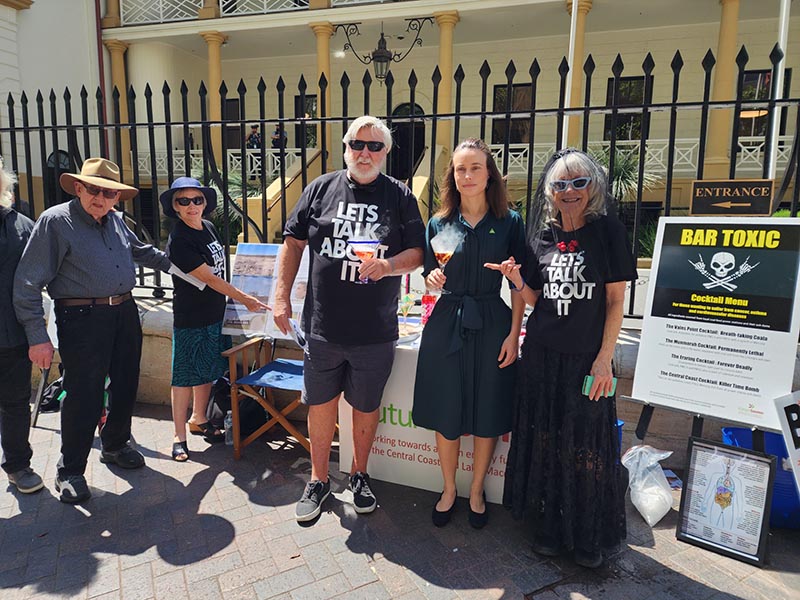
Future Sooner members (from left) Gill Boehringer, Merlene Thrift, Gary Blaschke, and De Brierley Newton with Dr Amanda Cohn (second from right) outside NSW Parliament to raise awareness of the health impacts of living near power stations and their ash dams.
26 August 2026
QUESTIONS asked by Dr Amanda Cohn MLC to Stephen Beaman Executive Director of Regulatory Operations at the NSW Environment Protection Authority (EPA) in Budget Estimates regarding the Government’s Draft Human Health Risk Assessment report (HHRA) were at odds with submissions submitted by the Central Coast community.
“There are the massive gaps in the HHRA draft report admitted by its author EnRiskS’ Jackie Wright,” said Gary Blaschke OAM spokesperson Future Sooner.
“The HHRA, contrary to Recommendation 6 of the Coal Ash Inquiry for an Epidemiological Assessment, was allegedly designed to help protect the health of citizens living on the Central Coast and at Lake Macquarie.
“How could it when conjecture and assumptions replaced major gaps in actual evidence and the report made no attempt to answer the question: are coal-fired power stations making people sick?
“Then there are what appears to be major fissures' in Stephen Beaman’s memory.
“Under oath Mr Beaman was asked how long he had a copy of the HHRA. His reply: “I think I got it a couple of weeks ago. I actually sat on the committee.”
“As a Future Sooner representative on the Coal Ash and Health Community Advisory Committee (CAHCAC) I know that NSW Health and the EPA received the draft HHRA on 14 April 2026.
“I also know that it was only after I lobbied David Ross, Chair of CAHCAC in June, that the Committee was finally sent a digital copy of the draft report on 25 June 2026. That’s almost three months after NSW Health and the EPA had it.
“Mr Beaman also said he ‘sat on the committee’. I’m not sure where he sat or on what committee as there is no record of him having anything to do with CAHCAC, or the Coal Ash Inquiry Committee.
“Perhaps Budget Estimates could recall Mr Beaman to clarify his statements? On behalf of Future Sooner, I would be happy to assist Estimates in helping to clarify the facts and refresh his memory.”
The endemic problem with how the NSW Environment Protection Authority (EPA) handles Draft Human Health Risk Assessments, is failing to account for know facts reported by the community and therefore assuming "ideal" or restricted exposure scenarios, which underestimates real-world contact. Excluding baseline health data by overlooking local background disease rates—such as elevated asthma, respiratory illness, or cancer clusters—when calculating community vulnerability is common-place.
The intersection of the NSW Coal Ash Parliamentary Inquiry, Lake Munmorah, and the NSW EPA’s Budget Estimates testimony represents a fierce battleground between community advocates, politicians, and environmental regulators.
"Gaping holes" and bureaucratic evasion regarding Lake Munmorah traces directly to the contamination, decommissioning, and health oversight of the former Lake Munmorah Power Station. This site was declared "Significantly Contaminated" by the NSW EPA due to heavy PFAS and petroleum hydrocarbon pollution.
The specific "gaping holes" and "memory loss" dynamics raised by community alliances (such as Future Sooner and the Coal Ash Community Alliance) target several critical oversights, such as the forgotten unlined ash dam.
Community groups highlight that while operational stations get intense focus, the decommissioned Lake Munmorah ash dam was largely ignored for years under a system of industry self-regulation, allowing heavy metals and asbestos conduits to remain uncontained near local waterways. Yet the EPA maintains that seafood from the Tuggerah Lakes system remains safe to eat. However, critics point out "gaping holes" in the testing pool — specifically, that the assessment overlooks bioaccumulation in bottom-dwelling organisms close to the San Remo outlet canals.
Community advocates argue that failing to link the historic toxic dust blown over surrounding residential zones into a singular cumulative health risk assessment invalidates the findings.
Unsurprisingly, when questioned during Budget Estimates about the sluggish response to the Lake Munmorah site - including why it took until 2024 to declare it significantly contaminated - despite years of known power station foam use, EPA officials experienced convenient "bureaucratic memory loss".



.jpg?crc=4257584689)


_web.jpg?crc=282450513)


SUBSCRIBE FOR FREE to the Grapevine News Online and to the monthly e-book edition of the Grapevine Community Weekly. Our online news platform and monthly newspaper is about real local news and events. We will not spam you or share your details with third parties.
