





Government must stand firm against AI
Tech giants OpenAI and Anthropic are placing immense pressure on the Albanese Government to dilute Australia’s copyright laws, warning that multi-billion-dollar investments in local artificial intelligence and data centre infrastructure will hang in the balance unless the country reshapes its intellectual property frameworks.
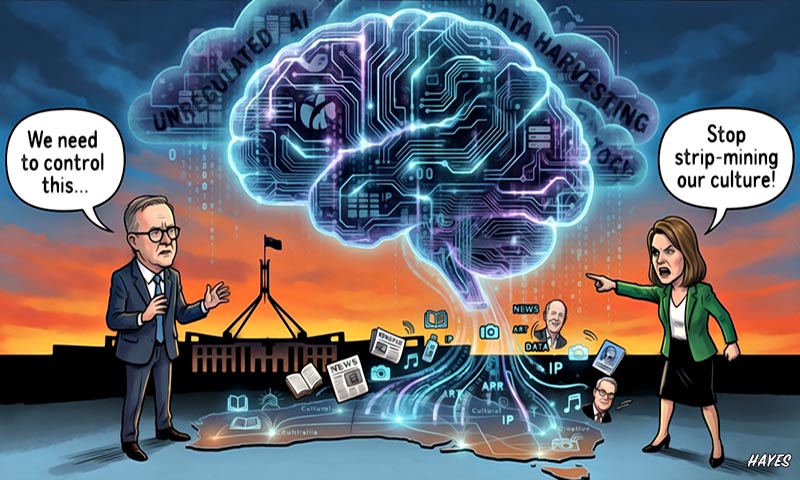
The aggressive lobbying campaign has ignited a fierce political storm in Canberra, pitting Silicon Valley’s most powerful firms against local artists, media companies, and a wary crossbench determined to protect Australian culture from being "strip-mined" by foreign algorithms.
The dispute centres on how generative AI models—such as OpenAI’s ChatGPT and Anthropic’s Claude—are trained. To build their systems, these companies scrape massive volumes of data from the internet, including copyrighted articles, books, music, and art. While the tech giants argue this constitutes fair use, Australian creators and copyright lawyers maintain it is large-scale intellectual property theft.
21 October 2026
ALAN HAYES
IN private submissions and recent high-level meetings with senior government ministers, both OpenAI and Anthropic have given Australia an investment ultimatum, making it clear that Australia risks missing out on the next wave of global tech infrastructure if it maintains a strict stance on copyright.
The companies have pushed for the introduction of broad "text and data mining" (TDM) exemptions. These exemptions would effectively allow AI models to crawl, scrape and ingest Australian creative content without needing to secure licensing agreements or pay upfront royalties to content creators.
According to sources close to the negotiations, Anthropic has proposed a conditional "opt-out" framework. Under this model, AI firms would have the legal right to scrape Australian intellectual property by default. If a local author, journalist, or artist does not want their work used, the burden would fall entirely on them to actively block the AI company's data crawlers.
Tech lobbyists have framed the changes as an economic necessity. They argue that Australia’s current regulatory environment is a major barrier to innovation, warning that without "copyright clarity," major data centres and advanced model-training facilities will be built in jurisdictions with more permissive laws instead.
The simple answer is: show the would-be thieving bastards the door! In what world do these AI tech billionaires believe they have the right to steal someone else's intellectual property to line their pockets with gold? As the author of numerous successful books, why should I be burdened with the responsibly of actively blocking AI data crawlers - copyright laws are there for a reason; not to be watered down or tampered with because it doesn't suit the business model of this new den of thieves.
"Earn your sociallLicence": Albanese responds
The escalating pressure has forced a delicate balancing act from Anthony Albanese. Speaking to reporters on the matter, the Prime Minister acknowledged the immense economic potential of artificial intelligence but struck a protective tone regarding the nation’s creative sectors.
Albanese noted that global AI labs are already utilising local creative works without payment or consent, a reality that his government is under intense pressure to regulate. He insisted that any policy framework introduced by his administration must ensure Australia remains "in control" of its digital sovereignty.
"Technology companies cannot simply take what they want without regard for the people who created it," Albanese said, adding that global tech giants need to "earn" their social licence to operate smoothly within Australia.
Despite the firm rhetoric, internal government divisions have begun to leak. Reports suggest that the government has quietly explored potential compromise mechanisms to appease the tech sector, while at the same time selling out Australian creators. While a blanket, uncompensated text and data mining exception has been publicly ruled out, leaked consultation papers reveal the bureaucracy has weighed up a centralised or distributed payment system. Under such a system, tech companies could still scrape content under an opt-out framework, provided they paid into a collective fund that would later distribute micro-payments to creators.
Creative sector warns of "cannibalisation"
The prospect of any dilution to Australia's copyright protections has triggered absolute outrage across the nation's media and arts landscape.
Australia's public broadcasters have led the charge against the tech lobby, presenting a united front with commercial media networks. In a joint warning, the broadcasters cautioned that allowing AI models to freely ingest journalism would result in the "cannibalisation" of local news. They argued that AI engines scrape trusted, expensive-to-produce journalism to generate summarised search answers, directly starving the original media organisations of traffic, subscription revenue, and advertising dollars.
Author alliances, visual artists, and musicians have expressed similar panic. They argue that an "opt-out" system is inherently unfair, as individual independent creators lack the technical expertise, legal resources, and time required to police giant multi-national tech conglomerates.
"We are talking about the wholesale theft of Australian cultural identity," said one prominent industry representative. "If the government capitulates to these threats, local creators will effectively be forced to subsidise the wealthiest tech corporations in human history with their own unpaid labour."
Backlash on the Crossbench
The political stakes for the Albanese Government are incredibly high. The Greens and influential crossbench independents hold the balance of power in the Senate, and they have already signalled that any attempt to weaken copyright laws to please Silicon Valley will face an immediate blockade.
Greens Senator Sarah Hanson-Young fiercely condemned the lobbying tactics of OpenAI and Anthropic, accusing them of corporate bullying.
"These foreign tech giants are coming into our country and holding investment over our heads like a gun, demanding the right to strip-mine Australian culture," Senator Hanson-Young said. "The Greens will not stand by and watch local artists, writers, and journalists get ripped off so that a few billionaires in California can train their software for free."
“The Albanese Government must stand behind its promise not to undermine Australia’s copyright laws.
“It’s no secret that Anthropic and OpenAI are pressuring the Albanese Government to dilute our copyright laws, which work to protect Australian artists from having their work scrapped without their knowledge or permission.
“It’s concerning to see that the letter from the Joint Committee on AI, written by the Prime Minister’s Office, was filled with the talking points of the AI companies.
“AI companies may want us to move at hyperspeed, but it’s important that the parliament doesn’t rush. We must get the regulations for AI companies right.
“To protect our artists, creators and everyday Australians from having their work and content scrapped and replicated by big AI, Australia’s copyright framework cannot be undermined.
“Australian creators must be given the consent, credit and compensation they deserve.
“AI is the new extractive industry, taking a page straight out of the fossil fuel industry’s playbook. Without the right rules in place, AI companies will strip mine Australia’s culture, exploit the work of our creators and pocket the profits."
Independent Senator David Pocock also voiced deep skepticism over the promised investment windfalls, questioning the long-term societal cost of sacrificing intellectual property rights. Pocock urged the government to stand firm, arguing that a robust, fair creative economy is worth far more to Australia's future than data centers built on the exploitation of local creators.
A global battleground
The unfolding showdown in Canberra is part of a much larger, global legal battle. Around the world, AI companies are facing dozens of high-profile lawsuits from publishers, record labels, and bestselling authors who claim their copyrights have been systematically violated.
While the United States relies on its elastic "fair use" doctrine—which is currently being tested in the courts—the European Union has taken a much stricter approach, enforcing transparency requirements and giving creators strong rights to opt out of data mining.
Australia has traditionally maintained a highly protective copyright regime, lacking a broad American-style fair use exception. Because of this, OpenAI and Anthropic view the country as a critical regulatory battleground. If they can successfully pressure a Western democracy like Australia into relaxing its laws, it could set a powerful precedent for other nations weighing up similar artificial intelligence regulations.
For the Albanese Government, the choice ahead is stark: stand firm with local creators and risk missing out on highly coveted tech infrastructure investment, or rewrite the rules of intellectual property to secure Australia's place in the global AI boom, at the risk of alienating the entire creative workforce and facing a devastating defeat in parliament at the next election.





SUBSCRIBE FOR FREE to the Grapevine News Online and to the monthly e-book edition of the Grapevine Community Weekly. Our online news platform and monthly newspaper is about real local news and events. We will not spam you or share your details with third parties.
