





Minns-ing the Rule of Law:
The "Oops, We Lost" Bill
After the Grapevine's report on 28 October 2026 (The Death of a Landmark Victory) exposing the Minns Government's rush to introduce legislation to nullify a High Court Ruling, we have been inundated with emails of concern about the state government treading upon a slippery slope to authoritarian rule.
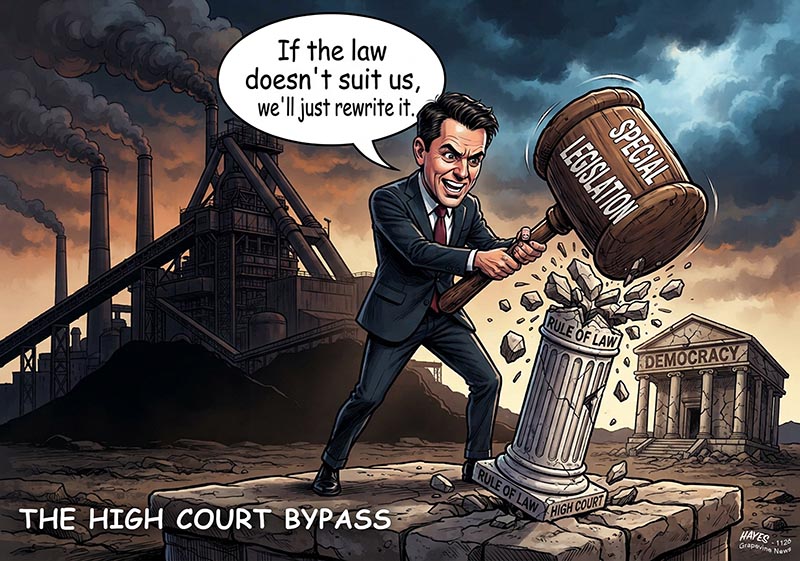
The decision by the New South Wales Government, led by Premier Chris Minns, to introduce special legislation directly overriding a significant High Court ruling has ignited an intense and polarised debate across the state's legal, political, and environmental landscapes. While the government frames its intervention as a necessary measure to protect thousands of regional jobs and secure the state's economic interests, legal scholars, civil liberties advocates, and independent crossbenchers have raised profound alarms. They argue that using parliament to retrospectively dismantle a judicial decision threatens the bedrock of democratic governance: the separation of powers. It becomes nothing less than moving to the Rule of "Because We Said So", enabling retrospectivity to the fossil fuel industry and guaranteeing political donations continue by using a large parliamentary hammer—justice perverted, justice denied.
11 November 2026
ALAN HAYES
TO understand the gravity of the anxieties currently reverberating through constitutional law circles, critics argue it is necessary to examine how democratic institutions can be systematically eroded from within. Throughout history, the transition from a robust constitutional state to an authoritarian regime rarely occurs overnight; instead, it is often paved by successive legal workarounds, executive overreach, and the subordination of the judiciary to political or economic expedience.
The most extreme and frequently studied historical example of this phenomenon occurred in Weimar Germany during the early 1930s. While contemporary New South Wales remains a stable, peaceful democracy—and nobody suggests that the state faces a literal descent into totalitarian fascism—political scientists and legal historians point out that the structural mechanics of executive overreach share a worrying conceptual lineage. In the final years of the Weimar Republic, before the outright suspension of democratic norms under the Nazi regime in 1933, the rule of law was progressively hollowed out by the normalisation of emergency decrees and legislative interventions designed to bypass constitutional checks and balances. When a government establishes a precedent that judicial decisions can be simply erased by arbitrarily by a legislative or governing body by sheer command or decree, rather than through extensive consensus-building, customary process, or natural social evolution, because it does not suit the state’s immediate political or economic agenda, then it chips away at the core barrier that prevents executive dominance.
The Community Environment Network (CEN), and its member group Climate Future, argue that The proposed Special Legislation would compromise the integrity and independence of the NSW Planning System. "The special legislation sets a dangerous precedent and asks that any proposed expansion of existing operations by MACH Energy Australia at Mount Pleasant be subject to the assessment processes required under NSW planning law," a CEN spokesperson said.
"The outcome of the judicial review in this matter should be respected by the NSW Government. The Government’s attempts to circumvent the decision suggest state capture by the mining company against the interests of the NSW community."
The separation of powers under pressure
At the heart of the current controversy in New South Wales is the principle of the separation of powers—the constitutional doctrine that divides the functions of government into the legislature (which makes the laws), the executive (which administers the laws), and the judiciary (which independently interprets and applies the laws). This system ensures a vital set of checks and balances, guaranteeing that the government of the day remains subject to the law as determined by an independent bench.
When the High Court issued its recent ruling, it did so by interpreting existing legal frameworks, setting a binding precedent regarding environmental obligations and the assessment of long-term projects. In a traditional democratic framework, if a government disagrees with a judicial interpretation, its standard recourse is to prospectively amend legislation to clarify future policy directions. However, the introduction of "special legislation" explicitly designed to retrospectively overturn a specific court decision and insulate a single project from judicial scrutiny represents an entirely different mechanism.
Critics argue that this approach effectively signals to the public and corporate interests that a judicial victory against the state is meaningless. If ordinary citizens, community groups, or environmental organisations spend years and significant financial resources navigating the rigorous pathways of the court system to achieve a landmark legal victory, only to have that victory instantly wiped out by a bespoke Act of Parliament, the perceived utility and authority of the judiciary are profoundly undermined.
The slippery slope: Historical parallels with the 1930s
The invocation of 1930s Germany by some of the more vocal critics of the Minns government’s legislation is not meant to imply an equivalence of intent or scale, but rather to highlight a structural vulnerability in democratic design.
In the early 1930s, the Weimar Republic's democratic framework was dismantled largely through legal and constitutional mechanisms. Long before the Reichstag Fire Decree or the Enabling Act of 1933 formally consolidated absolute power, the executive branch under Chancellors like Heinrich Brüning routinely relied on Article 48 of the constitution to govern by executive decree, bypassing a fractured and deadlocked parliament. Simultaneously, the judiciary was increasingly pressured to align its rulings with the economic and political priorities of the state.
The primary lesson of that era is that the degradation of democracy begins when the executive decides that constitutional processes are too slow, too inconvenient, or too disruptive to state interests. When the Nazi party formally took power in 1933, they did not immediately tear up the constitution; instead, they used a series of retroactive laws, special tribunals, and legislative overrides to normalise the idea that the "will of the state" superseded any independent judicial determination.
When modern legal observers express concern over the Minns government's special legislation, they are identifying a similar underlying logic: the assertion that economic necessity or executive convenience justifies the subordination of a court ruling. The danger is the creation of a precedent. If parliament can pass an emergency bill to overturn a court ruling on a coal mine today, there is no structural barrier preventing a future government from passing special legislation to overturn judicial decisions regarding civil liberties, protest rights, property ownership, or electoral laws tomorrow.
Economic expedience vs. constitutional integrity
The Minns government has strongly defended its legislative intervention, pointing to the immediate socioeconomic consequences of leaving the High Court's ruling unaddressed. The project in question represents billions of dollars in economic activity, critical regional supply chains, and the livelihoods of thousands of workers in communities that depend heavily on resource extraction. From the executive’s perspective, allowing a judicial ruling to suddenly halt a major economic driver would cause widespread disruption, job losses, and energy instability during an already challenging economic period.
Government alignment with corporate and industrial stakeholders underscores a classic democratic dilemma: how to balance long-term institutional integrity against immediate, tangible economic crises. Proponents of the bill argue that the legislature, as the democratically elected representative body of the people, possesses the ultimate mandate to determine the state's economic direction, and that using parliamentary sovereignty to correct a disruptive legal outcome is a legitimate exercise of governance.
However, constitutional lawyers counter that parliamentary sovereignty was never intended to act as an escape hatch whenever the executive loses a court case. True democratic resilience requires a government to accept the decisions of the courts, even when those decisions are economically painful or politically inconvenient. Bypassing the judiciary to protect a specific industry creates a double standard, suggesting that powerful economic entities can secure legislative intervention to escape legal judgments that ordinary citizens are forced to endure.
The threat to public trust
Beyond the technical constitutional arguments, the controversy poses a significant threat to public trust in democratic institutions. A healthy democracy relies on a shared consensus that the rules of the game apply equally to everyone, including the state itself. When a government changes the rules retrospectively after a final whistle has blown in the courts, it fosters cynicism and disillusionment among the electorate.
This erosion of trust is precisely what occurred in the fragile democratic landscape of the early 1930s. As the German public witnessed state institutions constantly bending, shifting, and rewriting laws to serve immediate political struggles or powerful industrial cartels, faith in democracy collapsed. This systemic disillusionment left the population receptive to authoritarian rhetoric that promised order and efficiency at the expense of legal niceties.
While New South Wales is far from such a crisis of faith, the normalisation of special legislation to bypass judicial checks risks nudging the political culture down a dangerous path. It frames the judiciary not as an independent arbiter of truth and law, but as a bureaucratic obstacle to be managed or overridden by the executive.
The debate surrounding the Minns government's special legislation highlights the delicate nature of constitutional democracy. While the immediate focus remains on regional employment and economic stability, the broader implications touch upon how a society protects its core institutional boundaries.
By utilising parliament to retroactively undo a High Court decision, the government has prioritised short-term economic management over long-term constitutional conventions. The historical warnings of the 1930s remind us that democracies are rarely dismantled by sudden, overt acts of destruction; instead, they are gradually weakened whenever an executive branch decides that the rule of law is an inconvenient barrier to its immediate goals. As this legislation proceeds through the parliament, the true cost may be measured not in the preservation of industrial jobs, but in the subtle, compounding erosion of the state's democratic foundation.
You can express your disgust and concern at the Chris Minns 'High Court Bypass' and sign the petition here by filling in the form at the end of the press release.





SUBSCRIBE FOR FREE to the Grapevine News Online and to the monthly e-book edition of the Grapevine Community Weekly. Our online news platform and monthly newspaper is about real local news and events. We will not spam you or share your details with third parties.
