





Mortgage mayhem on cup day
Last weeks story, Stoking the Inflation Fire, like many of our reports, saw the Grapevine's inbox flooded with comments from angry mortgage holders venting about the Reserve Bank of Australia's latest rate hike. There was so much correspondence that we decided to continue our report into the plight and anger of so many struggling Australian families.
While money was furiously changing hands on Melbourne Cup Day, mortgage holders and struggling families were only guaranteed one sure bet: the Reserve Bank of Australia (RBA) was intent on inflicting more punitive pain, expecting them to carry the burden for the country’s rising inflation. It was a move that has blindsided millions of Australian homeowners and ignited a wildfire of political fury, pushing borrowing costs to levels not experienced since the depths of the 2008 Global Financial Crisis.
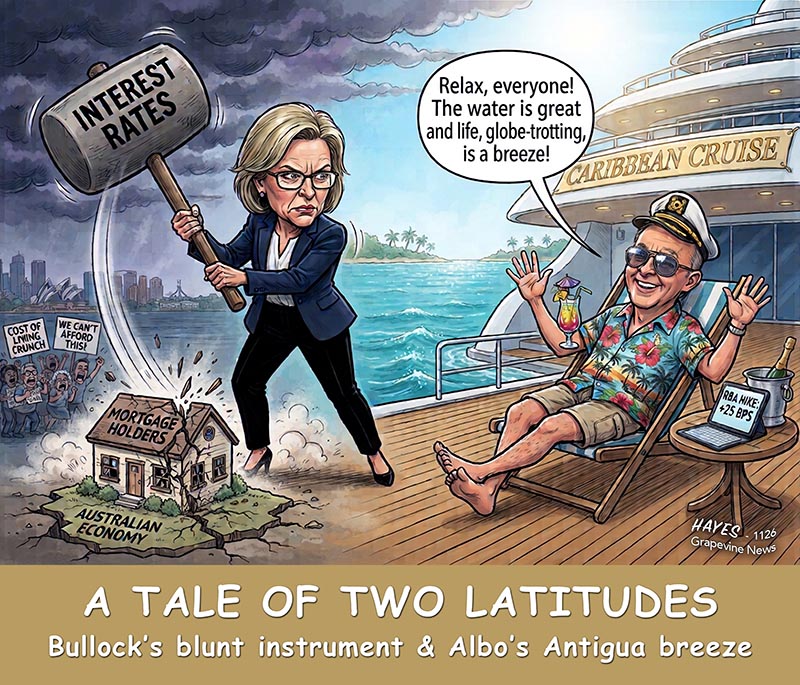
Compounding the widespread financial pain was a fierce public backlash directed at Prime Minister Anthony Albanese. Critics and desperate families have lambasted the nation's leader for "globe-trotting" to an international summit in the Caribbean. The Prime Minister reportedly took time at taxpayers' expense to stay on a luxury super-yacht belonging to a prominent billionaire just as the central bank pulled the monetary trigger at home.
This “globe-trotting” contrast, between struggling families on the domestic mortgage belt and the Prime Minister’s high-flying international schedule, sparked widespread outrage, providing the Coalition with heavy ammunition to paint the government as entirely detached from reality.
11 November 2026
ALAN HAYES
THE RBA's decision last week channelled an immediate wave of severe financial distress through the roughly 3.3 million households currently carrying variable-rate mortgages. According to data from financial comparison site Canstar, this single 0.25 per cent jump instantly slugged a household holding a median $700,000 home loan with an extra $107 in monthly repayments.
When combined with the four prior rate hikes delivered throughout 2026, the cumulative impact has added a staggering $532 per month—or over $6,300 a year—in pure interest expenses to the average family budget. Analysis compiled by property platform REA indicates that mortgage repayments on a median-priced Australian home will now consume an astonishing 37.4 per cent of a typical household’s income. This pushes the real economic burden on families to the brink of the historic 37.5 per cent record established in December 1989.
"We are officially at breaking point," said a Central Coast mother of three, who spoke to the Grapevine about the RBA’s announcement. "Our family budget has been completely shredded this year. Every single dollar we have goes straight to the bank now. We don't buy new clothes, we've cut out fresh meat, and I don't know how we're going to pay our electricity bill next month. To watch the Prime Minister, fly out of the country while our lives are collapsing feels like a sick joke."
An arsonist complaining about the fire
Before boarding his flight to the Caribbean for the Commonwealth Heads of Government Meeting (CHOGM), Prime Minister Albanese attempted a pre-emptive strike against the independent central bank, publicly categorising official interest rate hikes as a "blunt instrument" that disproportionately squeezes household borrowers.
However, the political insulation tactic backfired catastrophically. The federal opposition and prominent economic commentators immediately seized upon the comments, framing the Labor administration's fiscal strategy as the primary driver behind the persistent domestic inflation that the RBA is trying to curb.
"The Prime Minister coming out and trying to lecture the Reserve Bank is an extraordinary act of political hypocrisy," said Shadow Treasurer Angus Taylor in a fiery press conference outside Parliament House. "Anthony Albanese having a crack at the RBA is like an arsonist complaining about getting his fingers burnt. This government continues to spend like a drunken sailor, pumping billions of dollars of structural cash into the economy, and then they cry crocodile tears when the central bank has to clean up their mess."
The political optics worsened drastically following revelations that the Prime Minister's itinerary included luxury accommodation and down-time aboard billionaire Twiggy Forrest’s private yacht in the Caribbean.
"A lot of Australians woke up to see the news that the Prime Minister had flown to the other side of the world at taxpayers' expense to hang out on a yacht owned by a billionaire," noted independent Senator Jacqui Lambie. "They are going to be thinking, 'Has he lost his mind, or has he just completely lost touch?' It is a direct kick in the guts for mortgage holders around this country, who were explicitly promised cheaper mortgages under a Labor government. He should be right here in Canberra facing the music and fixing the structural crisis he helped (to) create."
Sticky inflation and domestic realities
In the official Monetary Policy Statement released by the RBA Board, Governor Michelle Bullock confirmed that the decision to lift rates was driven by stubbornly high, broad-based domestic capacity pressures. Trimmed mean inflation—the central bank's preferred core metric—climbed to 3.7 per cent in the three months to September, defying the bank's internal forecasts of a drop to 3.5 per cent. Concurrently, headline inflation surged to 4.3 per cent, heavily accelerated by a 9.4 per cent spikes in domestic petrol costs and global supply chain disruptions linked to ongoing conflicts in the Middle East.
Alarmingly, the RBA's revised internal forecasts now indicate that inflation will remain elevated deep into 2027, delaying a return to the strict 2-3 per cent target band until at least mid-2028—roughly three quarters later than previously assumed.
"We cannot allow inflation expectations to drift permanently higher," RBA Deputy Governor Andrew Hauser warned in a recent economic address, setting the stage for last week’s aggressive intervention. "There is an increasing share of businesses who are thinking that maybe 3 to 3.5 per cent is the new normal. That is a central banker's nightmare."
Structural spending squeezing the bank
While Treasurer Jim Chalmers held the line in Canberra last week, defending the federal budget and arguing that government policy was not responsible for the rate spike, macroeconomic experts are pointing fingers directly at fiscal policy. Recent global data confirms that Australia currently leads the developed world in interest rate hikes for 2026, outstripping the United States, Canada, and the Eurozone, which have already begun flattening or cutting their respective cycles.
"The RBA is effectively being forced to fight an economic war against the Albanese government's domestic spending agenda," stated Leith van Onselen, Chief Economist at MacroBusiness. "Our central bank has been backed into a corner by homegrown inflation brought on by low national productivity and reckless public sector spending expansions. We are now tied with developing nations for the sheer volume of rate hikes this year, while our peer economies are safely winding down their tightening phases."
The federal government has repeatedly deflected blame, with Finance Minister Katy Gallagher citing unyielding, structural spending pressures from the National Disability Insurance Scheme (NDIS), the AUKUS security pact, and interest payments on a gross national debt approaching $1 trillion. Yet, for the average citizen, those explanations provide zero comfort. Yet Treasurer Jim Chalmers continues to defend the budget strategy.
Chalmers maintains that investments in health, childcare, and wages boost workforce productivity will ease immediate household stress without feeding the inflationary fire. Despite Chalmers political rhetoric, it is abundantly clear that the government’s strategies are not working. With underlying inflation refusing to budge comfortably into the RBA's 2% to 3% target band, critics warn that the government's refusal to rein in aggregate demand is leaving everyday Australians to pay the ultimate price through prolonged high interest rates.
Hobnobbing with the elite
Images of the Prime Minister mingling in the Caribbean with King Charles III and mining magnate Andrew "Twiggy" Forrest aboard a multimillion-dollar mega-vessel have added immense fuel to an already roaring cost-of-living fire. The optics could not have been more damaging: while everyday families were forced to sacrifice basic necessities to absorb their fifth rate hike of the year, Albo was sailing through tropical waters at the invitation of royalty and billionaires.
The high-profile gathering took place in the island nation of Antigua and Barbuda, where the leaders converged for the Commonwealth Heads of Government Meeting (CHOGM). Albanese joined the King on deck of the Fortescue Green Pioneer—a 75-metre, low-carbon prototype vessel owned by Forrest—to launch a landmark environmental initiative. Even as the global summit focused on noble causes like climate change and habitat protection, the staggering disparity between the luxury of a Caribbean ship launch and the grim economic reality facing Australians back home sparked immediate accusations that the Prime Minister has completely lost touch with Australians.
Political rivals blasted the trip as a complete betrayal of mortgage holders who were explicitly promised cheaper home loans, arguing that the leader should have been in Canberra facing the music and addressing the systemic, homegrown inflation squeezing local budgets. Even a light-hearted exchange on board—where the Prime Minister mentioned the media backlash to the King, prompting Charles to joke, "Oh God, it's all my fault!"—served only to infuriate struggling borrowers, who felt their economic pain was being treated as a casual punchline on a billionaire's deck.
From the sunny shores of Antigua, Albanese firmly defended his attendance, arguing that trade diversification and active global engagement are crucial steps toward strengthening Australia's long-term national security and economic interests.
Yet for millions of desperate families, staring down hundreds of dollars in added monthly repayments, those macroeconomic explanations offered zero comfort while their leader cruised through paradise.
Voices from the edge: mortgage holders react
Outside of the macroeconomic debate, the ground-level human cost is staggering. In suburban communities across Australia, the narrative is one of desperation, anger, and a total loss of confidence in the nation's political leadership.
"My husband and I are both working full-time, and we've taken on weekend gig-work just to keep up with our variable loan," said a high school teacher from Gosford. "When we bought our home, we were told by Labor that we'd see economic stability. Instead, we've had five rate increases in a single year. Our bank variable rate is moving towards 8 per cent. Seeing photos of Albanese smiling overseas while we are forced to skip meals to ensure our kids can go to school makes me utterly furious."
The commercial sector is bracing for the fallout as well. Small business groups have warned that the combination of plunging consumer confidence, falling home prices, and last week’s 25-basis-point increase will drive consumer discretionary spending into the ground.
"This is the tip of the spear," warned a veteran retail consultant. "Small businesses are already dealing with massive energy and wage bills. By shrinking household disposable income even further on Cup Day, the RBA and the government are ensuring a severe retail recession as we head into the crucial Christmas trading period."
With the RBA explicitly leaving the door open for further rate increases in its updated policy notes, and some independent economists predicting up to six more hikes, if domestic demand refuses to cool, the pressure on the Albanese government is set to intensify.
And, for Anthony Albanese? As the Prime Minister sailed the Caribbean, the political storm waiting for him back home looked entirely unmanageable.





SUBSCRIBE FOR FREE to the Grapevine News Online and to the monthly e-book edition of the Grapevine Community Weekly. Our online news platform and monthly newspaper is about real local news and events. We will not spam you or share your details with third parties.
