






Rate hike amid crumbling
infrastructure and council waste
Across the leafy avenues of the Woy Woy peninsula, the sprawling residential estates of the northern suburbs, and the winding rural roads of the hinterland, a familiar and bitter chorus is rising among Central Coast residents.
Following the Independent Pricing and Regulatory Tribunal’s (IPART) announcement of a 4.3 per cent rate peg for the 2027–28 financial year, frustration with Central Coast Council has boiled over into open revolt. For thousands of households already buckling under the weight of elevated mortgage repayments, soaring grocery bills, and a compounding series of local government charges, the latest hike feels less like a fiscal necessity and more like an insult.
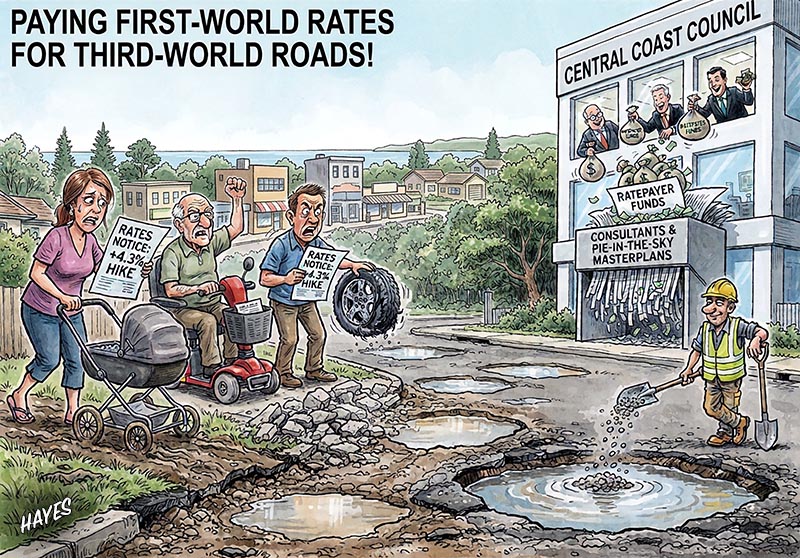
Ratepayers argue they are trapped in a one-sided financial arrangement: paying steadily climbing rates and utility fees while receiving visibly deteriorating basic services in return. From axle-breaking potholes and missing footpaths to an alleged administrative bloat and perceived enthusiasm for inappropriate high-density development, the disconnect between Wyong’s civic chambers and the region’s suburban streets has rarely looked wider. Property owners are sick and tired of being treated like a ‘council milch cow’ and paying First-World rates for Third-World service and roads.
18 November 2026
ALAN HAYES
TO UNDERSTAND the compounding burden on household budgets and the depth of public anger over the 4.3 per cent cap, residents point out that the figure does not exist in a vacuum. It arrives on the heels of a 3.2 per cent rate peg in 2026–27, a 5.5 per cent IPART-approved hike to water and sewer charges, and the lingering financial sting of the 15 per cent Special Rate Variation (SRV) imposed during Council’s infamous financial collapse and administration period.
While Council routinely notes that the IPART peg caps overall general rate revenue rather than applying a uniform percentage to every individual notice—meaning actual bills fluctuate alongside NSW Valuer General land valuations—the reality at the kitchen table is an unmistakable upward trajectory.
"Every single year, the envelope lands in the letterbox and the number goes up, yet when you walk out your front door, the street looks worse than it did twelve months ago," said Margaret Henderson, a retired nurse who has lived in Woy Woy for thirty-two years. "We were told the massive 15 per cent rate hike a few years back was the medicine we had to swallow to fix the mess they made. Well, we swallowed the medicine, we’re still paying for it, and now they want another 4.3 per cent on top. Where is the money actually going?"
For working families in growth corridors like Hamlyn Terrace, Woongarrah, and Wadalba, the frustration is equally acute.
"Between water, sewer, and general rates, Council is taking thousands of dollars out of our household budget every year," said David Kowalski, a local tradesman and father of three from Wyong. "If I ran my business the way Council runs this region—charging clients more every year while delivering half-finished jobs and ignoring basic maintenance—I’d be out of work inside a month."
'Patch-and-pray': The crisis on Central Coast roads
Nowhere is the gap between ratepayer expectations and Council delivery more visible—or more expensive for motorists—than on the region’s 2,200-kilometre road network.
Across social media community groups from Umina Beach to Toukley, daily posts document blown tyres, bent rims, and damaged suspension components caused by deep, water-filled craters. Residents accuse Council maintenance crews of relying on a "patch-and-pray" methodology: shovelling loose cold-mix asphalt into wet holes, only for the aggregate to wash out during the next coastal downpour.
"It is completely negligent," said Greg Thornton, a delivery driver based in Kincumber who clocks hundreds of kilometres across the Coast each week. "You watch a crew come out, throw a bit of tar into a pothole, pat it down with the back of a shovel, and drive off. Three weeks later, after one decent rainstorm, the hole is twice as big as it was before, and there’s loose gravel sprayed all over the road. They aren't fixing anything; they’re burning ratepayer money twice or three times on the exact same stretch of bitumen."
The frustration extends beyond reactive pothole filling to wholesale road rehabilitation. Residents in older suburbs such as Ettalong Beach, Long Jetty, and Bateau Bay complain that residential streets have been left to disintegrate to the point where the underlying road base is failing.
"Our street hasn't been properly resurfaced in more than twenty-five years," said Susan Vella, a resident of Bateau Bay. "The edges are crumbling away, tree roots have buckled the bitumen into speed bumps, and heavy trucks rattle our windows every time they hit the dips. We are paying first-world rates for third-world roads."
To top it all off, we have roads like Dickson Road in the Dooralong Valley, where patched potholes quickly reopen and now make up more of the surface than the original bitumen. Mother Nature has added her own special touch, too, with a growing network of ever-widening and long cracks in the road surface. If the grass keeps sprouting through them, Council’s road crews will soon need lawnmowers for road maintenance.
Missing footpaths and absent kerb and guttering
If the state of the roads angers motorists, the lack of basic pedestrian infrastructure—specifically footpaths, kerbs, and guttering—infuriates parents, seniors, and residents with mobility challenges.
Despite the Central Coast’s ageing demographic and rapidly expanding family suburbs, vast swathes of established residential areas remain completely devoid of concrete footpaths. In suburbs across the Peninsula, Terrigal, Killarney Vale, and Lake Haven, pedestrians are routinely forced to walk on uneven, overgrown grass verges or step directly onto busy roadways alongside speeding traffic.
"Try pushing a double pram or walking a child to school along a street with no footpath and no kerb after it rains," said Sarah Jenkins, a mother of two from Killarney Vale. "The grass verge turns into a bog, cars are parked half on the nature strip, and you end up having to walk on the road with your kids while cars fly past at fifty or sixty kilometres an hour. It’s an accident waiting to happen."
For older residents relying on mobility scooters or walking frames, the absence of continuous kerbing and accessible ramps effectively traps them in their own neighbourhoods.
"I pay over two thousand dollars a year in rates, and I can’t safely take my mobility scooter four-hundred-metres down the road to the local shops because there’s no footpath and no proper kerb ramp," said Arthur Pendergast, an 81-year-old ratepayer in Umina Beach. "When it rains, water pools across the driveway aprons because there’s no guttering to carry it into the stormwater system. You call Council, you get a reference number, and nothing happens for years."
Drainage failures tied to missing kerb and guttering remain a persistent flashpoint. In low-lying suburbs around Tuggerah Lake and Brisbane Water, heavy rain routinely inundates front yards and turns unkerbed streets into shallow creeks, eroding driveways and breeding mosquitoes long after the clouds clear.
'Pie-in-the-Sky' inefficiencies and administrative bloat
While residents are told there is insufficient capital to lay concrete footpaths or properly reconstruct failing suburban streets, ratepayers point to what they view as misplaced priorities, bureaucratic inefficiency, and questionable spending inside Council’s operations.
Critics frequently target spending on consultant reports, masterplans, corporate rebranding exercises, and strategic frameworks that rarely translate into tangible improvements on the ground. Among residents, these initiatives are widely dismissed as "pie-in-the-sky" projects disconnected from core municipal responsibilities.
"Council loves spending hundreds of thousands of dollars on glossy strategy documents, precinct visioning workshops, and consultants telling them what locals already know," said Peter MacPherson, a former small business owner from Gosford. "Meanwhile, the basic stuff—roads, rates, and rubbish—gets treated like an afterthought. Every time they create a new strategic plan, it seems to sit on a shelf gathering dust while the potholes outside get deeper."
Public resentment has also been fuelled by optics surrounding executive pay and staffing structures. News earlier in 2026 of a 3.5 per cent pay increase for Council’s chief executive officer sparked widespread condemnation across community forums, particularly among pensioners and wage earners struggling to absorb rising living costs.
"When ordinary families are cutting back on groceries and heating, watching top executives get pay rises while asking ratepayers for another 4.3 per cent is a slap in the face," a ratepayer who wished to remain anonymous said. "There is zero accountability for performance. If the roads are failing and development applications are bottlenecked, why are bonuses and pay increases being handed out at the top?"
Development application (DA) processing times remain another major source of friction. Mum-and-dad homeowners seeking approval for modest renovations, granny flats, or carport extensions report waiting months—and sometimes over a year—for basic assessments, often facing shifting requests for additional reports that inflate private costs.
"We waited eleven months for a straightforward renovation approval, jumping through endless bureaucratic hoops and paying thousands in extra consultant fees just to satisfy contradictory requests from different departments," said Claire Bennett, a homeowner in Terrigal. "The left hand doesn't seem to know what the right hand is doing."
Conversely, the rural valleys and hinterland water catchment districts face a different threat. Newcomers from Sydney are frequently clearing and damaging the natural environment on newly purchased properties without understanding or obtaining the required Development Approval (DA). Rather than enforcing the law, Council routinely excuses these unauthorised works, demonstrating a failure to uphold the strict legislative requirements governing water catchment areas.
Anger over inappropriate development and lost amenity
Compounding frustration over slow DAs for ordinary homeowners is a widespread perception that Council is overly eager to facilitate large-scale, high-density, and out-of-character developments that strain already overstretched local infrastructure.
Across coastal villages, town centres, and environmentally sensitive corridors, resident action groups have repeatedly mobilised against multi-storey apartment blocks, dense townhouse complexes, and commercial expansions that locals argue ignore height limits, erode neighbourhood character, and exacerbate chronic parking shortages.
"They claim they have to accommodate population growth, so they wave through massive developments that jam hundreds of extra cars onto local streets that already don't have footpaths, proper drainage, or decent road surfaces," said Helen Vance, a community advocate from Ettalong Beach. "Where is the infrastructure to support this density? You can’t just keep cramming more units into coastal suburbs without upgrading the sewer pipes, the stormwater drains, and the local roads first."
In areas bordering bushland and coastal wetlands, environmental concerns add another layer to ratepayer discontent. Locals accuse planning authorities of prioritising developer contributions and rate-base expansion over tree canopy retention, wildlife corridors, and flood mitigation.
"The very things that make the Central Coast special—the bushland, the relaxed coastal villages, the space to breathe—are being bulldozed to build boxy developments that look like western Sydney," said Mark Doyle, a resident of Kincumber. "And the irony is that even with all these new dwellings generating extra rate revenue, our services haven't improved one bit. It begs the question: who is this growth actually benefiting?"
Council’s financial balancing act
For its part, Central Coast Council has consistently maintained that its budgeting decisions are constrained by rising construction costs, strict statutory obligations, and the long-term legacy of its 2020 financial crisis.
In setting the 4.3 per cent rate peg for 2027–28, IPART pointed to higher base operating expenses across NSW councils, a doubled population growth factor of 0.4 per cent, and a new 0.46 per cent allowance specifically earmarked for cybersecurity upgrades. Council officials have previously emphasised that inflation in civil construction materials—such as bitumen, concrete, and fuel—has outpaced general consumer inflation, eroding the purchasing power of every rate dollar collected.
Furthermore, managing a geographically vast region split between two major urban centres (Gosford and Wyong), dozens of distinct coastal villages, and extensive rural hinterland creates unique logistical and financial pressures compared to compact metropolitan councils.
Yet for residents on the ground, economic explanations offer little comfort when they look at their bank statements and their front streets.
A looming showdown ahead of the 2027–28 Budget
Crucially, IPART’s 4.3 per cent figure represents a legal ceiling rather than an automatic increase. The elected councillors of Central Coast Council still hold the power to determine whether to adopt the full 4.3 per cent rise, apply a lower percentage, or adjust how the rating burden is distributed across residential, business, and farmland categories when they debate the draft 2027–28 Operational Plan and Budget in early 2027.
Ratepayer associations are already signalling their intention to mount a coordinated campaign during the public exhibition period, demanding a forensic audit of administrative overheads, a freeze on non-essential strategic spending, and a ring-fenced boost to capital works for suburban road reconstruction, footpaths, and drainage.
"Councillors need to remember who elected them and who pays their allowances," said Margaret Henderson from Woy Woy. "If they rubber-stamp another 4.3 per cent hike without cutting the waste and fixing our basic streets and footpaths, they’re going to hear about it at every community meeting—and they’ll definitely hear about it at the ballot box."
For now, as the occasional rain storm continues to test patched-up potholes and unkerbed gutters across the region, Central Coast ratepayers remain united in a simple demand: before Council asks for another cent, it needs to get the basics right.





SUBSCRIBE FOR FREE to the Grapevine News Online and to the monthly e-book edition of the Grapevine Community Weekly. Our online news platform and monthly newspaper is about real local news and events. We will not spam you or share your details with third parties.
