




Segal report: a threat to free speech
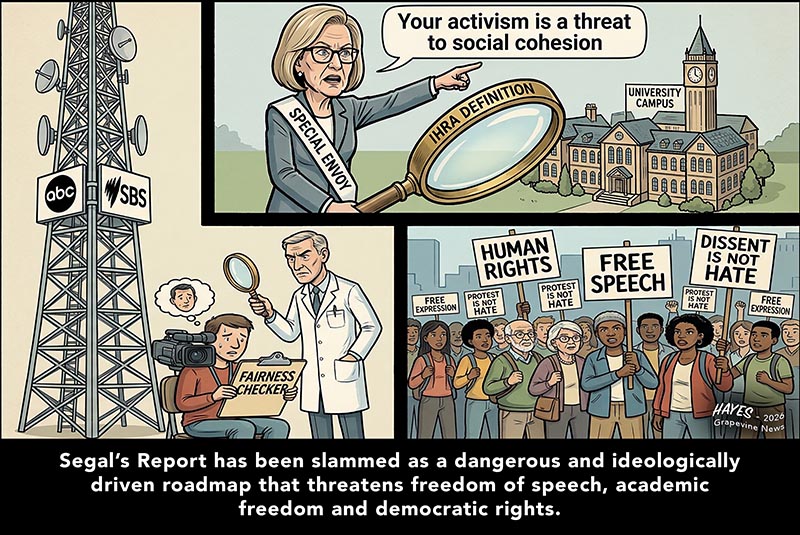
Jillian Segal’s updated report on combating antisemitism, released on 30 October 2026, has drawn fierce criticism from human rights groups, legal experts, and progressive organisations, who argue it poses a direct threat to free speech, academic freedom, and democratic rights in Australia.
The Jewish Council of Australia has condemned Segal the report as a dangerous and ideologically driven roadmap that threatens freedom of speech, academic freedom and democratic rights, while failing to meaningfully address the causes of antisemitism. They have called on the Australian Government to reject the report’s authoritarian recommendation.
Segal, the Federal Special Envoy to Combat Antisemitism, has, in her latest blueprint, targeted what she defines as "progressive antisemitism"—which she calls the most pervasive form of anti-Jewish hate in the country—and recommends far-reaching structural interventions across public institution.
Critics argue that Segal's report represents an unprecedented overreach that seeks to suppress legitimate political dissent under the guise of tackling racism.
4 November 2026
ALAN HAYES
AUSTRALIA'S peak civil liberties groups, legal experts, public broadcasters, and progressive Jewish organisations have united in condemnation against a sweeping new federal roadmap to combat antisemitism, warning that its recommendations present an unprecedented threat to free speech, academic freedom, and democratic norms.
The updated blueprint, titled ASECA Priorities and released on 30 October 2026, outlines a series of aggressive policy interventions aimed at public institutions. While Ms Segal argues the measures are necessary to push a modern wave of anti-Jewish prejudice "back to the margins," critics contend the report seeks to weaponise legitimate anti-racism concerns to systematically stifle political dissent and public criticism of the State of Israel.
The release comes exactly ten months after a devastating terror attack targeted a Jewish festival at Bondi Beach, which killed 15 people and dramatically altered the national security conversation around antisemitism and social cohesion. However, observers note the report's ultimate focus represents a significant tactical pivot, moving away from conventional far-right or extremist violence and aiming directly at social justice movements, media independence, and universities.
The new pervasive threat: 'Progressive Antisemitism'
At the core of Ms Segal’s report is the identification of what she terms "modern, progressive antisemitism" as the most dominant and dangerous manifestation of anti-Jewish hate currently active in Australia.
According to the roadmap, this variant combines elements of far-left and Islamic extremist ideologies, using the traditional lexicon of human rights, anti-racism, and social justice as a "respectable face" to disguise hostility toward Israel and Jewish citizens. Ms Segal argues that influential public spaces—including university campuses, media outlets, and arts organisations—have become hotbeds, where Jewish Australians are systematically blamed and vilified for the geopolitical actions of the Israeli government.
"Antisemitism does not begin with violence. It starts with words, and it grows when hatred is excused," Ms Segal said during the launch. She maintained that the document does not seek to suppress fair commentary, asserting that under the International Holocaust Remembrance Alliance (IHRA) definition, used by her office, standard criticism of Israel similar to that levelled against any other nation is explicitly permitted.
However, opponents argue that the operational reality of the report tells a fundamentally different story. By designating the core language of international human rights law—including documented legal allegations of apartheid, ethnic cleansing, and genocide—as coded antisemitic narratives, critics say the blueprint effectively categorises legitimate human rights advocacy as illicit hate speech.
Broadcasters defend independence against media oversight
One of the most legally and politically sensitive aspects of the report is its direct target on public broadcasters. Citing widespread concern from sections of the Jewish community regarding "subjective, inaccurate, and disproportionate reporting" on the war in Gaza, Ms Segal has called for the establishment of an "external independent ombudsman" or "fairness checker" to oversee Middle East coverage at the ABC and SBS.
The blueprint demands absolute transparency regarding the specific definitions of antisemitism used by media outlets and warns that editorial standards must not inadvertently amplify hostile narratives.
The proposal was immediately and publicly rejected by both networks. An ABC spokesperson defended the national broadcaster’s existing oversight mechanisms, describing them as "the most robust and transparent in the Australian media". The ABC stated: "The ABC has the highest editorial standards and a comprehensive framework to ensure accountability, transparency and high editorial standards. This framework is designed to balance accountability with editorial independence and robust journalism."
SBS also rejected the proposal, defending its internal Ombudsman and external review mechanisms, while experts warned external oversight risks censorship.
Punitive measures in higher education and the arts
The report proposes strict financial penalties and funding withdrawals for institutions failing to address antisemitism, alongside staff terminations and protest restrictions on campuses. Legal scholars warn this threatens academic freedom. The arts sector faces similar funding conditions tied to political codes of conduct.
Deepening fractures in civil society
The report’s release has profoundly exacerbated ideological rifts within Australian civil society, drawing a sharp battle line between established community leadership and a rising wave of progressive advocacy. Rather than fostering social cohesion, critics argue the blueprint forces a false dichotomy between Jewish safety and universal human rights.
The Jewish Council of Australia stood at the forefront of the internal communal pushback, flatly rejecting the document's authoritarian framing. Executive Director Sarah Schwartz publicly countered the Envoy's roadmap, stating that true Jewish safety cannot be achieved by suppressing Palestinian or Lebanese voices, nor by silencing the growing number of Jewish Australians who openly dissent from Zionist ideology.
Simultaneously, major human rights organisations have raised the alarm over what they see as a dangerous blueprint for institutional censorship. Some legal observers have described the proposals as "Trumpian" and "authoritarian," noting that by weaponising the IHRA definition, the report creates an environment where civil liberties are conditional.
By demanding that public service workers, artists, and academics align with a highly specific geopolitical stance, the report has turned workplaces, campus squares, and newsrooms into deeply polarised cultural battlegrounds, threatening the very fabric of Australia's multicultural consensus.
Critics have urged the government to reject policies that threaten democratic norms.





SUBSCRIBE FOR FREE to the Grapevine News Online and to the monthly e-book edition of the Grapevine Community Weekly. Our online news platform and monthly newspaper is about real local news and events. We will not spam you or share your details with third parties.
