





Stoking the inflation fire
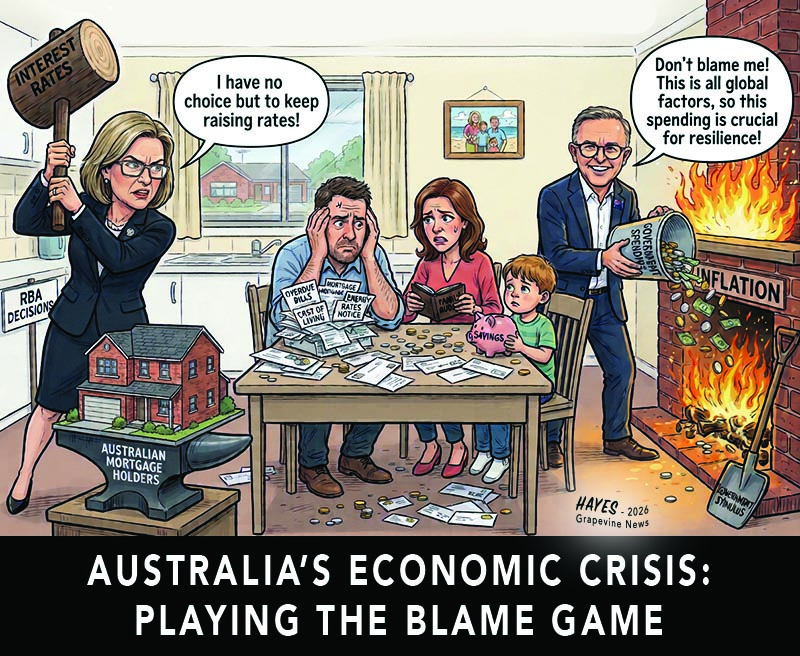
It came as no surprise yesterday that the Reserve Bank of Australia (RBA) put the heads of struggling families on the ‘block’—wielding their large punishment mallet to pound them headlong into total penury.
Once again, the burden of inflation is rigid adherence to a singular, one-eyed economic model—that clearly isn’t working—regardless of the human cost. And what better timing to rub the faces of hard-pressed families into the financial dirt than on Melbourne Cup Day—fiduciary abuse, while those who enjoy the financial windfall of the RBA’s failure celebrate.
There is little doubt that the new Robin Hood of Martin Place, and her not so compassionate band of indifferent bandits, care little about applying a uniform mechanism to an unevenly distributed crisis. An approach seen by consumer advocates as showing disinterest to the daily struggles of low and middle-income families by effectively forcing a specific group—suburban mortgage holders and renters—to carry the financial burden of stabilising the national economy.
Yet, the underlying forces driving this crisis remain completely outside the control of ordinary Australians.
4 November 2026
ALAN HAYES
THE RBA’s choice to again hike up interest rates will impact of millions of Australian households. Their decision has taken the official cash rate to an 18-year high of 4.85 per cent, trapping mortgage holders and struggling families in a deepening economic crisis—significantly elevating the risk of a recession.
Once again, Michelle Bullock and the RBA Board have got it wrong. Their monocular focus reveals the limitations of using a blunt instrument to address modern, structural inflation.
Interest rate hikes are designed to curb inflation by reducing excess demand, working under the assumption that consumers are spending too freely. However, current inflation is heavily driven by essential living costs, such as energy utilities, healthcare, insurance premiums, and rent. These are inelastic expenses; families cannot simply choose to stop paying for electricity or shelter. By increasing borrowing costs in this environment, the RBA does not reduce discretionary spending for these households; instead, it reduces their ability to afford basic necessities.
Furthermore, this strategy creates a stark economic divide. While high-income households with substantial savings or fully owned properties remain relatively unaffected—and can even benefit from higher returns on deposits—young families and first-home buyers are facing severe financial strain. The RBA’s data-driven approach, which often focuses on aggregate household resilience and offset account balances, tends to obscure the severe financial distress experienced by vulnerable segments of the population.
This persistent focus on tightening monetary policy, despite clear signs of rising financial hardship and growing demand for emergency community services, highlights a systemic vulnerability. Because the RBA lacks the regulatory authority to address supply-side issues, corporate pricing strategies, or tax policy, it continues to use its single available tool. For millions of struggling Australians, this creates an environment where the RBA appears less like an objective manager of economic stability and more like an institution relying on a punitive measure that penalises vulnerable families for economic imbalances they did not create.
The dynamic between the aggressive RBA approach and a free-spending government has now left middle-class families trapped permanently in a brutal pincer movement, without any way out except absolute and non-ending misery that is reaching its breaking point.
“We had an inflation challenge in our economy... but this war in the Middle East is absolutely turbocharging those cost of living pressures, which the RBA don't care about," said a Central Coast father of three to the Grapevine.
"I worry about my family and how my wife and I will continue to manage... paying the mortgage has become a major concern for us.
"What does Michelle Bullock expect us to do, wave a magic fairy wand... or does she expect us to live off fresh air?
"I bet she's not struggling in her fancy $2 million holiday home up the north coast. Nor is she having to live off toast and baked beans. The RBA Board members need a dose of reality.”
A recent landmark national report revealed that a staggering 3.6 million Australian households (one in three) have struggled to secure enough food over the past year. This has impacted families and middle-income earners, who have been forced to prioritise their home loans over basic groceries.
The mechanism of wealth transfer
The RBA’s persistent interest rate hikes have fundamentally altered the distribution of wealth in the country, accelerating a deep social and economic divide. By relying entirely on the cash rate to cool the economy, the RBA has created a two-tiered society: one where vulnerable families face severe financial hardship, while wealthy households and the banking sector see their financial positions strengthen.
This division stems directly from how monetary policy transmits through different parts of the population.
When the RBA lifts the cash rate, it creates a direct transfer of wealth from net debtors to net savers and financial institutions:
- The Burden on Struggling Families: For low-to-middle-income families, recent first-home buyers, and renters, higher rates act as a direct financial penalty. These households hold the vast majority of the nation's variable debt. Because their incomes are primarily swallowed by inelastic, essential costs—like groceries, fuel, utilities, and skyrocketing rents passed down by stressed landlords—every rate increase forces immediate, painful sacrifices in their standard of living.
- The Benefit to Wealthy Households: Conversely, older, wealthier demographics who own their homes outright or hold substantial capital are largely insulated from borrowing costs. Instead, higher interest rates actively boost their incomes via elevated yields on term deposits, bonds, and high-interest savings accounts. This allows affluent consumers to maintain, or even increase, their discretionary spending on luxury retail, travel, and services, driving the very inflation the RBA is trying to suppress.
- The Windfall for the Banking System: Sitting between these two groups is the commercial banking system, which has generated record profits throughout the tightening cycle. Banks are notoriously quick to pass the full weight of RBA hikes onto mortgage holders, yet they are much slower and less generous when lifting rates for depositors. This widening gap—known as the Net Interest Margin (NIM)—extracts billions of dollars from suburban households and channels it directly into corporate profits and institutional shareholder dividends.
Long-term social consequences
The social consequences of the RBA's economic divergence extend far beyond temporary monthly budget pressures. By squeezing the financial capacity of young families, while rewarding older capital holders, the RBA is entrenched in an intergenerational wealth gap. Younger Australians are increasingly locked out of the property market as borrowing capacities shrink, while those who managed to buy are forced to liquidate assets or take on multiple jobs just to keep their homes. Meanwhile, asset-rich investors continue to expand their portfolios, using their insulated financial positions to outbid families for scarce housing.
This policy trajectory effectively uses a vulnerable minority of the population as a macroeconomic shield. By forcing debt-heavy households to cut their consumption to the absolute bone to compensate for the uninhibited spending of the wealthy, the RBA achieves its aggregate inflation targets at the cost of fracturing Australia's egalitarian social fabric.
Better ways forward: Controlling inflation responsibly
To fight inflation without triggering a wave of home foreclosures, alternative economic strategies must be deployed:
- Implement Strict Fiscal Caps: The federal government should instantly cap non-essential infrastructure and departmental spending to reduce overall economic demand without altering frontline services.
- Targeted Corporate Excess Regulation: Rather than lowering household budgets, regulatory scrutiny should focus on supply-chain price gouging in sectors like supermarkets and corporate energy.
- Address Housing Under-supply: Red tape and high government fees on developers must be reduced to clear the way for immediate housing construction, addressing the root cause of skyrocketing rental costs.
- Broaden Productivity Reform: Boosting Australia's poor industrial productivity will naturally lower the baseline cost of running a business, dampening inflationary pressures organically.
The global shockwave: Trump's Middle East escalation
A primary driver of Australia's sticky inflation is the ongoing geopolitical conflict in the Middle East. Following severe military escalations involving the United States under Mad King Donald, global oil supplies have been heavily disrupted.
- The Fuel Crisis: Fuel prices have soared by over 35% this year. This shock directly injected an estimated 1.2% into Australia’s domestic inflation rate.
- The Collateral Damage: Working families are paying higher prices at the petrol pump while simultaneously being hammered by the RBA for a global energy crisis they did nothing to cause.
However, while global factors trigger the fire, critics argue the Albanese government is actively stoking the fire by burning more money. Shadow Treasurer Tim Wilson and Treasury officials have acknowledged that government spending continues to prop up artificial demand in the domestic economy.
Despite warnings from economists, federal spending has reached its highest non-pandemic levels in 40 years. For every dollar saved, the government reportedly commits more to the economy, driving up structural core inflation.
Treasurer Jim Chalmers, however, continues to dwell in the ‘land of the lost’, consistently defending the budget by deflecting blame entirely onto global wars. The reality remains, however, that domestic fiscal policy is misaligned with the RBA's monetary tightening.
A homegrown crisis
Australia’s escalating cost-of-living crisis has exposed deep structural failures in the Albanese government’s economic management. New economic data shows core inflation is dangerously high, driven by massive domestic price hikes, including a staggering 24.6% annual increase in electricity bills. The data confirms that Australia is suffering from a homegrown inflation problem that the current government is entirely failing to curb.
To add fuel to the inflation fire, former New South Wales Labor Treasurer Michael Costa delivered a blistering critique of his own party, stating the Albanese government has "no answers" to the country's systemic inflation crisis. “Rather than allowing the economy to stabilise,” he said, “continuous federal interventions and record-high public sector spending are actively keeping domestic price pressures artificially inflated. This leaves families and small businesses to pay the ultimate price.”
The economic strain is felt most acutely on the ground. Small businesses are trapped in a vice of rising operational outlays, high interest rates, and shrinking consumer spending. Meanwhile, supermarkets face ongoing intense scrutiny for record profits and alleged price gouging. Critics argue the government has merely offered reviews into food and grocery codes rather than deploying any immediate, heavy-handed legislative remedies to protect consumers.
So, while regular Australians are forced to severely slice their household budgets, the federal government refuses to meaningfully pull in its own belt. Economists warn that until Canberra halts its multi-billion-dollar domestic spending spree, inflation will remain entrenched, leaving families poorer and further degrading real wages across the nation.
All the while, Jim Chalmers hints at potential cuts to infrastructure projects in an effort to find savings. But economic analysts warn these measures may be too little, too late. By pumping billions into the public service and failing to exercise immediate fiscal restraint, the Albanese government has left regular Australians to shoulder the burden of prolonged economic pain.





SUBSCRIBE FOR FREE to the Grapevine News Online and to the monthly e-book edition of the Grapevine Community Weekly. Our online news platform and monthly newspaper is about real local news and events. We will not spam you or share your details with third parties.
