






Sweeping laws deny civil liberties
Controversial legislation granting the federal government expansive new powers to designate security zones, restrict public access, and override state and territory regulations has passed the Australian Parliament, triggering sharp condemnation from civil liberties advocates, legal bodies, and crossbench MPs.
Labor, the Coalition and One Nation rammed through the Bill after refusing to listen to unions and civil liberties groups on the chilling effect it will have on Australian democracy.
The public had less than a week to submit to an inquiry into this Bill, in a committee where no dissent was allowed, controlled by Labor and the Coalition, who only heard from Defence companies, lobbyists and the Department.
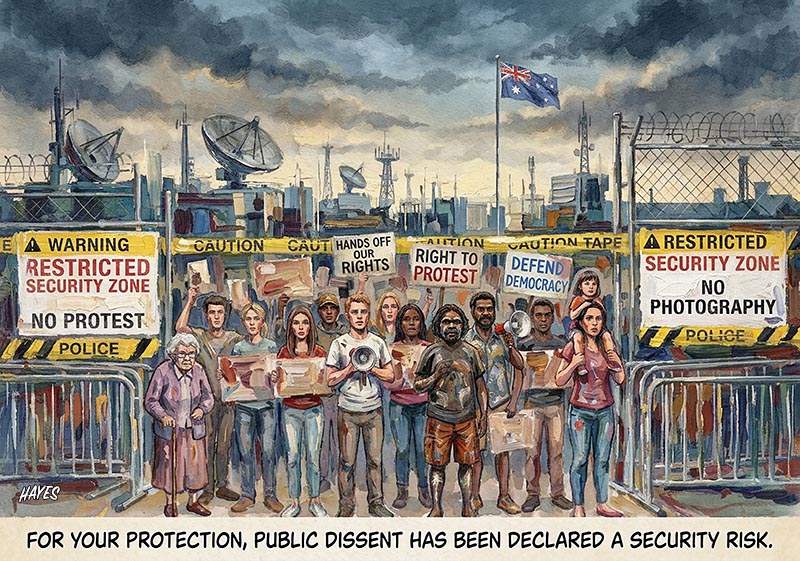
25 November 2026
ALAN HAYES
THE Defence Legislation Amendment (Accelerating Capability and Protecting Bases) Bill 2026 cleared its final parliamentary hurdles on 23 November 2026 after securing the backing of the Albanese Labor Government, the Coalition, and One Nation. While government ministers argue the 231-page statute is essential to modernise military infrastructure and counter emerging threats such as drone incursions, critics contend the laws represent an unprecedented peacetime encroachment on democratic rights and the right to peaceful protest.
These powers extend not just to Australian Defence personnel or law enforcement, but allow some of these powers to be extended to literally anyone, including representatives of arms companies and US military personnel.
This dangerous expansion of defence powers fundamentally changes the relationship between the Australian military and the Australian public.
The parliamentary process and criticisms of rushed scrutiny
Introduced to the House of Representatives on 27 October 2026 by the Department of Defence portfolio, the legislation moved through Parliament in less than a month. Following its introduction, the Bill was referred to the Parliamentary Joint Committee on Defence for review on 29 October, with public submissions closing just days later on 3 November.
Legal experts and crossbench senators criticised the compressed timeline, noting that the public was given roughly three business days—and only two in Victoria due to the Melbourne Cup public holiday—to examine the complex 231-page document. During the committee's sole public hearing on 30 October, witnesses were drawn exclusively from government departments and defence industry representatives, leaving civil society organisations, unions, and legal academics without an opportunity to testify in person.
Law Council of Australia President-Elect Elizabeth Shearer warned prior to the final vote that the speed of the inquiry undermined good lawmaking and prevented adequate scrutiny of provisions carrying severe criminal penalties. Similarly, Amnesty International Australia characterised the passage of the legislation as an erosion of freedom of expression and peaceful assembly pushed through under the banner of national security.
In the Senate, Greens Senator David Shoebridge led opposition to the Bill, describing Labor, the Coalition, and One Nation as "Australia's war parties" for uniting to pass what he termed "extreme wartime powers" during peacetime. Independent senators Lidia Thorpe and David Pocock, alongside independent MP Kate Chaney and Greens MP Elizabeth Watson-Brown, moved a series of amendments aimed at curbing the breadth of the powers and protecting protest rights, all of which were voted down by the major parties.
The government’s case: Modernising defence frameworks
Defending the legislation, Prime Minister Anthony Albanese dismissed claims of authoritarian overreach, telling reporters that critics were "jumping at shadows". Deputy Prime Minister and Minister for Defence Richard (Hon. Kentucky Colonel) Marles, alongside Assistant Defence Minister Peter Khalil, maintained that existing legislation had failed to keep pace with technological change and a deteriorating regional security environment.
According to the Department of Defence, the Act replaces fragmented, decades-old laws—including the Control of Naval Waters Act 1918 and the Defence (Special Undertakings) Act 1952—with two unified mechanisms:
*The Defence Capability Framework. This mechanism allows the Defence Minister to issue "capability declarations" to expedite the development, testing, evaluation, and sustainment of advanced military technologies. Government officials argue that civilian-focused regulatory schemes often delay vital defence projects and joint exercises with international partners.
*The Defence Security Zone Framework. This consolidates security rules across permanent military bases while allowing the creation of ordinary, temporary, emergency, mobile, and special defence security zones. Ministers specifically highlighted the need for clear legal authority to detect, track, and neutralise uncrewed aerial systems—or drones—operating near sensitive military sites.
To address accountability concerns, the government emphasised that the Act expands the statutory oversight functions of both the Inspector-General of the Australian Defence Force (IGADF) and the Parliamentary Joint Committee on Defence.
Sweeping powers and severe penalties
Despite government assurances, civil liberties groups and progressive think tanks such as the Australia Institute have raised alarms over the practical reach of the new provisions.
Under the Defence Security Zone Framework, the Minister can designate almost any location—spanning land, sea, or airspace—as a security zone. Crucially, these designations are not limited to traditional Australian Defence Force (ADF) bases. They can apply to privately owned commercial facilities, infrastructure projects, or mobile military convoys travelling on public roads. In some instances, temporary or emergency declarations can be exempted from public registration if the Minister determines that disclosure could prejudice national security or international relations.
Within and around these zones, the legislation establishes criminal offences carrying maximum penalties of up to seven years' imprisonment, fines exceeding $152,000, or both. Prohibited activities include entering a zone without authorisation, failing to comply with directions, or photographing and sketching a zone, equipment, or personnel inside it. Critics point out that several offences are framed with strict or absolute liability elements, meaning prosecutors do not necessarily need to prove a person intended to breach the law—raising fears that commuters, journalists, or peaceful demonstrators could face severe punishment for inadvertently filming or obstructing a mobile zone.
Leader of the Australian Greens, David Shoebridge said “The Prime Minister said Australians are jumping at shadows because of this extreme bill. They are actually jumping at the idea of being imprisoned for refusing orders from foreign military personnel.
“If Anthony Albanese does not think this Bill is an attack on civil liberties, he must not have read it. If he had, he would know it is not targeted at a foreign country; it's targeted at his fellow Australians. It protects foreign militaries from the Australian public.
“Labor has teamed up with the Coalition and One Nation to give the Defence Minister power to make almost anywhere or anything a ‘defence security zone’ and to imprison someone for obstructing one, even unknowingly.
“Australian citizens can face years in prison for just taking a picture of the bases under this law.
“These are extreme wartime powers that Labor, the Coalition, and One Nation are happy to give to the defence minister in peacetime, that make us all less safe."
Extension of authority to contractors and foreign militaries
A major focal point of opposition is the Act's broad definition of "defence security officials" and "area managers". Rather than restricting enforcement powers to sworn police officers or uniformed ADF members, the legislation allows the Minister, the Defence Secretary, or the Chief of the Defence Force to confer these roles upon public servants, private defence contractors, industry partners, and foreign military personnel.
Officials exercising these powers are authorised to demand identification, conduct searches of individuals and vehicles, refuse entry, seize items, and detain people within security zones.
Senator Shoebridge argued that the provisions fundamentally alter the relationship between the military and the Australian public by empowering foreign troops and private arms company employees to issue binding orders to Australian citizens on domestic soil. Digital Rights Watch also warned in its submission to the inquiry that the broad criteria for security zones could be used to shield commercial facilities—such as privately operated artificial intelligence data centres linked to defence contracts—from community opposition and environmental protests.
Overriding state and territory laws
Equally contentious is the Minister's new authority to issue capability declarations that exempt declared defence activities from complying with specified Commonwealth, state, or territory laws. While the legislation excludes serious criminal conduct—such as the unlawful use of force, sexual offences, and unauthorised intelligence collection—from these exemptions, critics note that it does not explicitly protect state environmental regulations, workplace health and safety standards, planning rules, or First Nations cultural heritage and land rights legislation.
Senator Thorpe and Indigenous advocates warned that the powers could be used to bypass Traditional Owner consent and state heritage protections when expanding military training areas or testing weapons systems.
“These extreme laws give the Defence Minister power to override any state or territory law they choose, including laws that protect Aboriginal land rights, cultural heritage, the environment and workers’ safety," said David Shoebridge.
“Labor and the Liberals are more interested in protecting AUKUS, their mate Trump, and US defence primes than protecting Australians’ democratic rights.
”Labor, backed in by the Coalition and One Nation, has committed a gross breach of trust by smashing this through without public scrutiny. The public will remember this betrayal.”
With the Bill now having passed both houses of Parliament and awaiting royal assent, legal observers and advocacy groups have indicated they will closely monitor the government's first use of the declarations. While the Albanese government maintains the reforms are a proportionate response to modern strategic realities, opponents warn that the true test of the legislation will be whether its sweeping powers are confined to genuine external threats or deployed against domestic dissent.





SUBSCRIBE FOR FREE to the Grapevine News Online and to the monthly e-book edition of the Grapevine Community Weekly. Our online news platform and monthly newspaper is about real local news and events. We will not spam you or share your details with third parties.
