






The AUKUS money hole
A33 million a day and counting! Based on the total projected program cost of A$268 billion to A$368 billion over a 30-to-31-year timeline (through the 2050s), the average daily AUKUS cost is roughly A$24.5 million to A$33.6 million per day.
In the 2024–25 financial year, the Australian government earmarked about A$2.59 billion for AUKUS, which works out to approximately A$7.1 million per day.
The federal government’s unwavering commitment to the AUKUS security pact has, however, transformed Australia’s strategic posture—escalating costs and a loss of military autonomy have sparked sharp domestic debate, in particular over the nation’s largest-ever defence undertaking.
Independent defence analysts, former diplomats, and even factions within the ruling Labor Party are increasingly warning that Australia’s headlong rush into AUKUS represents a profound geostrategic folly. Rather than securing sovereign independence, critics argue the project is anchoring Australia into an irreversible, one-sided reliance on Washington.
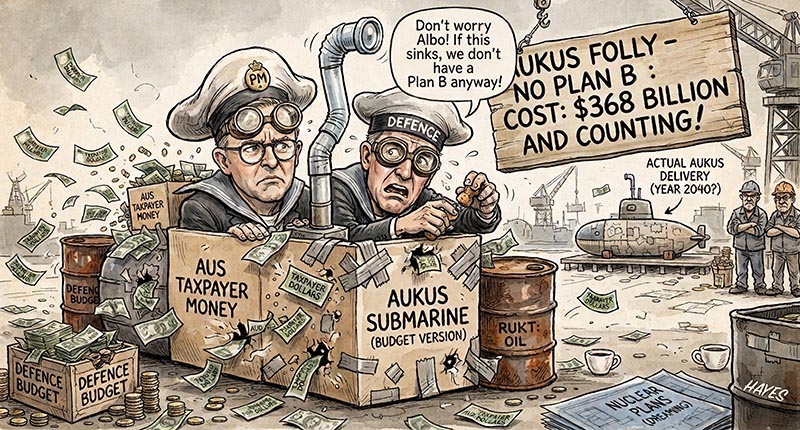
Defence Minister Marles has exemplified the government’s inability to convince even many within its own ranks that AUKUS represents either a worthwhile investment or a sensible strategy in relation to China, begs the question why Australia is being thrown into the lunatic world of Mad King Donald and his sycophantic army.
14 October 2026
ALAN HAYES
THERE seems to be little doubt that Defence Minister Richard Marles is viewed as exceptionally pro-American because of his role to lock Australia into a deep military integration with the United States.
Marles has behaved less like an independent decision-maker and more like a facilitator for a "real American agenda," prioritising US strategic objectives even when it erodes Australian sovereignty.
Under Marles' defence leadership, Australia has steadily increased its defence spending and expanded the footprint of American forces on Australian soil—absorbing pressure from the Trump administration to push defence spending targets higher. Rather than push back, Marles has welcomed an "acceleration in force posture initiatives," allowing deeper US military access to Australian bases across all domains.
It has been variously reported that Marles is overly enamoured by American political status and power. Journalists have pointed out that his ministerial office in Geelong is reportedly packed with US memorabilia (including an honorary certificate naming him a "Kentucky Colonel"). His eager diplomacy—such as rushing to Washington to "sandbag" AUKUS or secure meetings with key Trump lieutenants like JD Vance and Pete Hegseth—would seem no less than evidence of a desperate desire to please Washington, occasionally resulting in "diplomatic humiliations" when US officials treated the interactions as casual or happenstance.
Because AUKUS represents the biggest industry policy decision in decades (remembering it includes funding American industry as well as our own) and a step-change in Australia’s position regarding nuclear power, and the simple fact that Marles exemplifies the government’s inability to convince even many within its own ranks that AUKUS represents either a worthwhile investment or a sensible strategy in relation to China, begs the question why Australia is being thrown into the lunatic world of Mad King Donald and his sycophantic army.
Yet the fervour of Marles’ bipartisan commitment to America, leaves little doubt in the minds of critics that Australia is being elevated to the status of a vassal state of our would-be imperial lords in Washington.
Ground zero and the infrastructure rush
Nowhere is the AUKUS multi-billion-dollar fixation more visible than in Western Australia. Richard Marles recently declared WA’s Henderson shipyard as the nation's strategic "ground zero" ahead of the first rotational deployments of American and British nuclear-powered submarines.
Speaking on the sidelines of major defence conferences in Perth, Marles has repeatedly talked up the growing military importance of the state. The government’s blueprint demands a rapid overhaul of local infrastructure to support Submarine Rotational Force-West, which is scheduled to begin operating out of HMAS Stirling.
Yet, when pressed by journalists on exactly when construction would begin on the massive new Henderson precinct, the Defence Minister declined to provide specific dates. He maintained, however, a firm confidence that the site would be operational in time to anchor large-scale naval projects.
This relentless public optimism is facing growing scepticism. Analysts point out an unsettling paradox: Australia is investing heavily in bases, specialised training, maintenance facilities, and nuclear support infrastructure long before it possesses a single nuclear-powered submarine of its own. This infrastructure rush is occurring against a backdrop of a local shipbuilding sector and industrial capacity that many experts consider conspicuously fragile.
The submarine capability gap
The government's "all-in" bet on nuclear propulsion leaves no room for error. When grilled at the Indian Ocean Defence and Security Conference about the immense technical hurdles of the optimal pathway, Marles conceded that the government has no "Plan B" if the AUKUS framework fails. "To have a long-range capable submarine in the 2030s and 40s, it will need to have nuclear propulsion," Marles insisted, dismissing critics for failing to engage with the structural reality of modern maritime warfare.
This lack of a contingency plan has sparked alarm across the defence sector. The Royal Australian Navy’s existing six conventional Collins-class submarines are aging rapidly. To prevent a catastrophic drop in maritime capability before the nuclear fleet arrives, the government is forced to manage a complex, costly life-of-type extension program for the old fleet.
The timeline for the replacement vessels is also fraught with a geopolitical risk. Under the current agreement, Australia is slated to buy three used American Virginia-class submarines in the 2030s, moving away from an earlier plan that included a new-build vessel. Marles defended the shift in Parliament as a "good financial deal", asserting it was exactly the outcome Canberra desired.
However, former Australian Ambassador to the US Joe Hockey has publicly admitted he is "nervous" about whether Washington will actually deliver the boats given the severe backlog in America's own naval shipyards. If US shipbuilders fall short of their domestic requirements, Australia risks being left with no operational submarine capability at all.
Structural enmeshment vs. sovereignty
The core justification offered by the Albanese government for AUKUS is that nuclear-powered submarines are essential to maintaining national self-reliance and protecting maritime supply chains in a deteriorating regional security environment. Marles has continuously argued that without these long-range assets, Australia would become far more dependent on the US for its security.
However, a growing chorus of strategic thinkers argues that the exact opposite is happening. Rather than fostering independence, the sheer scale of AUKUS is driving a transition from alliance coordination toward total structural military enmeshment with the United States. This enmeshment steadily narrows Canberra's independent freedom of action, eroding the military autonomy that a serious middle power should protect.
This tension exposes a fundamental flaw at the heart of Australian governance. As former Department of Foreign Affairs and Trade Secretary Peter Varghese has observed, Australia's foreign policy officially embraces a multipolar future where no single country dominates. Yet, its defence policy is increasingly fixed around doing whatever it takes to ensure the retention of US strategic primacy in Asia.
By committing to a weapon system that cannot function without American technical data, logistical support, and oversight, Australia has effectively integrated itself into the Pentagon's forward-defence planning. Yet Marles raised eyebrows at the very thought of such an idea by stating that if war broke out between the US and China, Australia would inevitably be involved—a concession that critics describe as an unacceptable abdication of national sovereignty.
Secrecy and the Washington dynamic
The lopsided nature of the partnership with the US was laid bare during recent high-level diplomatic exchanges in Washington. Following the 40th AUSMIN meetings, the US Pentagon completed a comprehensive review of the AUKUS agreement. The review, helmed by US officials, suggested modifications to ensure the deal worked effectively for American interests.
Upon his return, Marles faced intense scrutiny when he refused to disclose the specific recommendations contained within the Pentagon’s report, abruptly telling reporters, "It’s America’s." He was unable to confirm whether the Australian government agreed with the changes or to provide any guarantee that the findings would ever be made public.
This high level of secrecy has deepened concerns that Australia is acting more as a compliant junior partner than an equal ally. While Washington maintains that the pact is going "full steam ahead," the political pressure on Canberra is mounting.
The US administration has consistently pressured the Australian government to guarantee that its future nuclear-powered fleet would be deployed in the event of a US-China conflict over Taiwan. While Prime Minister Anthony Albanese routinely insists that defence decisions remain matters entirely for Canberra, the structural reality of AUKUS makes neutrality in a superpower conflict functionally impossible.
Domestic fractures and base security
As the financial and strategic realities of the deal become clearer, the initial bipartisan consensus in Canberra is beginning to splinter. Internal divisions within the Labor Party broke into the open when senior figures, including federal cabinet minister Ed Husic, called for a fresh caucus vote on the arrangement. Arguing that the deal had fundamentally changed since its inception, Husic noted that the plan warranted a thorough rethink—a sentiment echoed by a public inquiry into the agreement.
Former Prime Minister Malcolm Turnbull has been even more unsparing, labelling AUKUS as a "one-sided" deal that left Mad King Donald "amazed" by how much Australia surrendered for so little in return. Yet beyond the political elite, the project also faces friction at the community level. In addition to concerns over the management of weapons-grade radioactive waste generated by the future fleet, local security anxieties are rising.
Following the implementation of the AUKUS Optimal Pathway, Australian agencies have been forced to rapidly upgrade physical and cyber protections across military installations to meet strict US security standards. Marles acknowledged that base security has moved "front and centre" for his department as Australia adjusts to operating its facilities in a significantly more challenging and heavily scrutinised strategic environment.
The peril of a singular focus
The government’s single-minded focus on AUKUS has arguably come at the expense of a broader, more balanced national security strategy. By locking up hundreds of billions of dollars in a single, high-risk maritime capability decades away from realisation, Australia is reducing its financial flexibility to adapt to more immediate defence needs.
With regional dynamics shifting rapidly, the insistence that there is "no Plan B" exposes the nation to a dangerous strategic vulnerability. If Washington's shipyards fail to deliver, or if a future US administration alters its commitments, Australia risks being left adrift—having sacrificed its military autonomy and billions of dollars in pursuit of a flawed strategic anchor.
A case for nuclear fallout
The Albanese government has faced fierce backlash over its handling of the AUKUS nuclear waste dilemma, with critics accusing it of rushing into a multi-billion-dollar military pact without a viable strategy to manage highly radioactive waste. Under the trilateral agreement, Australia is legally bound to dispose of weapons-grade, highly enriched uranium (HEU) from incoming submarines—a requirement experts warn creates an environmental crisis with no end in sight.
Independent lawmakers, the Australian Greens, and environmental watchdogs have condemned the legislation for stripping back state and territory environmental protections. Furthermore, new provisions give the federal government unprecedented power to unilaterally declare any Defence land a nuclear dump site, bypassing traditional community and First Nations consultation.
"They are treating the country like terra nullius all over again," stated the Australian Nuclear Free Alliance (ANFA), pointing to historical trauma from mid-century British nuclear tests.
Despite government assurances that high-level waste disposal will not be required until the 2050s, analysts argue the timeline is a dangerous gamble. Deep geological repositories take decades to plan and build, and Australia has repeatedly failed to secure a permanent home even for its low-level medical waste.
Moreover, critics argue that loopholes have left the door open for Australia to absorb operational and intermediate waste from visiting US and UK navies, transforming the country into an international "poison portal". And, unlike navies that use low-enriched uranium, Australia's AUKUS submarines, if they ever arrive, will run on highly enriched uranium (approx. 80% U-235), which can potentially be reprocessed for nuclear weapons and creates a sensitive non-proliferation precedent.
With multi-billion-dollar setup costs looming, the government's approach to AUKUS continues to draw heavy fire for prioritising military integration over long-term domestic safety, sovereignty, and environmental transparency.



.jpg?crc=4257584689)


_web.jpg?crc=282450513)


SUBSCRIBE FOR FREE to the Grapevine News Online and to the monthly e-book edition of the Grapevine Community Weekly. Our online news platform and monthly newspaper is about real local news and events. We will not spam you or share your details with third parties.
