





The death of a landmark victory
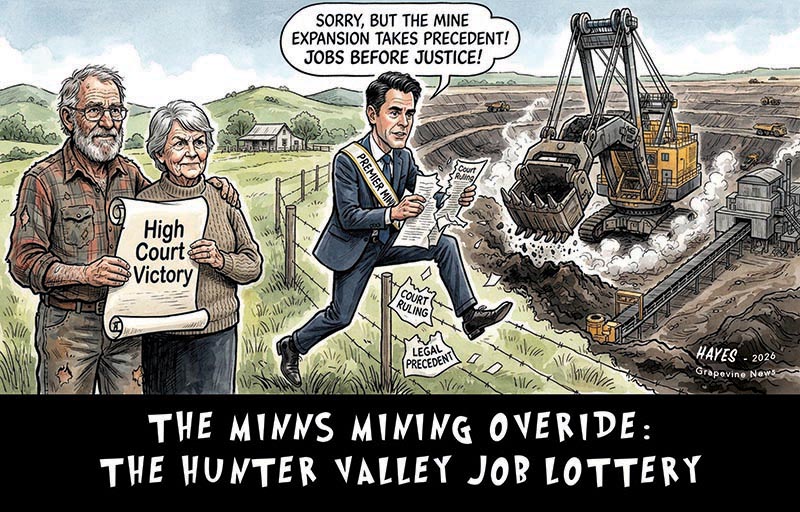
On 7 October 2026, the highest court in the Commonwealth of Australia delivered a judgment that was supposed to change history. In a tense, closely watched 3–2 decision, the High Court ruled in favour of the Denman Aberdeen Muswellbrook Scone Healthy Environment Group (DAMS HEG). Led by Wendy Wales and Tony Lonergan—two retired science teachers from the Upper Hunter, who had spent four gruelling years fighting a multi-billion-dollar corporate juggernaut—the court invalidated the approval for MACH Energy’s massive expansion of the Mount Pleasant coal mine.
28 October 2026
ALAN HAYES
FOR a few brief days, Wales, Lonergan, and the community they represented breathed a sigh of relief. The highest legal authority in the land had validated their science, their struggle, and their sovereign right to protect their farm, their air, and the global climate. The High Court’s ruling drew a clear line in the sand: the NSW Independent Planning Commission (IPC) could no longer ignore "Scope 3" emissions—the catastrophic atmospheric damage caused when exported Australian coal is burned overseas. It was a national precedent, a beacon of hope for environmental law, and a triumph of ordinary citizens over unbridled resource extraction.
Then came Monday, 19 October 2026.
With a single press conference, NSW Premier Chris Minns shattered that victory. Announcing that his Labor government would introduce extraordinary, standalone legislation to explicitly bypass the High Court’s ruling and hand MACH Energy its expansion anyway, Minns performed one of the most brazen acts of political capitulation in modern state history.
By overriding the judiciary to pander to the coal lobby, the Minns Labor government did more than just expand a coal mine; it undermined the separation of powers, sabotaged Australia’s climate commitments, and abandoned the very working-class communities it claims to represent. It is an act of political cowardice so profound that it strips the government of any moral or democratic legitimacy.
The direct assault on the Rule of Law
To understand why this decision is a disqualifying offence for a democratic government, one must first look at the mechanism of the betrayal. The Minns government is not merely tweaking a policy or adjusting a regulatory standard, it has undeniably used the raw power of a legislative majority to rip up a specific court order won by private citizens against a massive corporation.
Former Supreme Court Judge Anthony Whealy KC did not mince words when he condemned the intervention, labelling it "reprehensible." In a healthy democracy, the executive branch does not act as a security guard for corporate interests, jumping in to nullify judicial decisions the moment a wealthy donor or powerful industry group loses a case.
When ordinary citizens break a law or fail a regulatory test, they face the consequences. When a multinational mining company like MACH Energy fails a mandatory legal obligation to account for its environmental destruction, the Premier steps in to rewrite the laws on their behalf. This creates a deeply dangerous two-tiered justice system: one for everyday citizens, who must abide by the rulings of the courts, and another for the fossil fuel industry, which enjoys a permanent get-out-of-jail-free card issued directly by the Premier’s office.
By rendering a four-year High Court battle meaningless overnight, Minns has sent a chilling message to every community group, environmental defender, and everyday citizen in New South Wales: The law does not matter. Your courts do not matter. If you fight the coal industry and win, we will simply change the rules so you lose. This is an authoritarian overreach—a Trumpian playbook antic—that subverts the rule of law and a government that treats the judiciary with such contempt that it has forfeited its right to govern.
The myth of the "400 jobs" smokescreen
The Minns government has attempted to wrap its capitulation in the flag of the working class, arguing that the legislative intervention was an urgent, compassionate measure to save 400 direct mining jobs before Christmas. This is a classic, cynical scare tactic designed to pit workers against environmentalists, and it relies on a completely fraudulent premise.
The High Court did not order the immediate closure of the existing Mount Pleasant mine. It struck down the Optimisation Project—an aggressive expansion designed to double annual coal extraction to a staggering 21 million tonnes and prolong the mine's lifespan until 2048. The baseline, pre-expansion operations at Mount Pleasant were not under an immediate existential threat that required emergency legislation within 12 days of a court judgment.
Furthermore, if the Minns government were genuinely concerned about the welfare of these 400 workers, it had countless regulatory and economic levers at its disposal. It could have provided direct structural transition support, demanded that MACH Energy redeploy workers across its vast operations, or utilised existing state frameworks to sustain employment while a lawful, corrected planning application was transparently processed.
Instead, Labor chose the nuclear option. It bypassed the entire independent planning architecture of the state to grant the mine an immediate production boost to 16.5 million tonnes per annum until 2032. The "jobs guarantee" is a political shield used to obscure a deeper truth: the Labor Party remains structurally, financially, and ideologically dependent on the political patronage of the mining sector. Minns chose to protect corporate profits and coal royalties, using 400 families as human shields to justify an environmentally catastrophic handout.
"I was appalled by what Premier Minns did," said a regular Grapevine reader. "My husband and I live in the top end of the Central Coast and couldn’t believe what we heard. My husband has worked in the mines for so many years, and most of his friends are miners, but what the Premier did was sickening. He tried to blame the miners’ for his cowardly behaviour. There was no loss of jobs, just the denial of the expansion. We have been Labor voters all of our married lives, but no more.
"I hope you will publish my comments. I just felt I had to reach out to someone and your publication always gets to the truth for the everyday person. I never miss reading it each week, and the monthly print edition as well. The Grapevine is our favourite read."
Climate hypocrisy on a global scale
We are living through a climate emergency. New South Wales has been ravaged by unprecedented bushfires, catastrophic floods, and record-breaking heatwaves—a deep primal fear of devastating proof that the atmospheric limits of our planet have been breached.
The Minns government has repeatedly paid lip service to climate action, boasting of its transition targets and its commitment to renewable energy zones. Yet, when confronted with the reality of Scope 3 emissions, the government's rhetoric evaporates. The Mount Pleasant expansion is not a minor footnote in the state’s carbon ledger; it is a carbon bomb. Scope 3 emissions—the greenhouse gases generated when Australian coal is shipped overseas and burned in foreign power stations—accounting for roughly 98% of the project’s total climate impact.
By choosing to ignore these emissions, Chris Minns is engaging in an act of profound scientific and moral hypocrisy. The atmosphere does not care about national borders. Carbon dioxide emitted from an overseas blast furnace fuelled by Hunter Valley coal cooks the planet just as effectively as carbon emitted within the borders of New South Wales.
The High Court’s ruling was an historic breakthrough, precisely because it forced planning authorities to confront this physical reality. It recognised that New South Wales cannot claim to be a climate leader, while simultaneously acting as a primary drug pusher for the global fossil fuel addiction. By rushing to legislate away this precedent, the Minns government has firmly aligned itself with the forces of climate denialism and delay. They are actively choosing to accelerate the climate crisis, ensuring that future generations of Australians will inherit a state defined by environmental collapse.
The abandonment of the Hunter Valley’s future
The greatest tragedy of Labor’s coal pandering is that it actively harms the very region it claims to protect. The Upper Hunter is a community trapped in an economic chokehold by the fossil fuel industry. For decades, coal monopolies have swallowed up agricultural land, driven out sustainable industries like viticulture and equine farming, and polluted the air and water of local residents.
Wendy Wales and Tony Lonergan are not radical outsiders; they are local retired science teachers who understand the physical toll that coal extraction takes on their neighbours. They have watched dust clouds settle over Muswellbrook, listened to the ceaseless roar of heavy machinery, and feared for the long-term health of their community.
The Hunter Valley desperately needs a government with the courage, vision, and integrity to manage 'a just' economic transition. The global market for thermal coal is shrinking, and the transition away from fossil fuels is an inevitability dictated by economics and planetary survival. A responsible government would look at the High Court’s ruling as a golden opportunity—a structural pivot point to accelerate investment in renewable manufacturing, land rehabilitation, tourism, and sustainable agriculture in the Hunter.
Instead, Chris Minns has offered the Hunter Valley more of the same toxic dependency. By extending the life and scale of the Mount Pleasant mine, Labor is delaying the inevitable, ensuring that when the coal crash finally arrives, the economic fallout for local workers will be catastrophic. This is not leadership; it is predatory delay. It is an abandonment of the Hunter’s future for the sake of short-term political convenience.
A structural rot: The capture of NSW Labor
The capitulation over Mount Pleasant exposes a structural rot within the New South Wales Labor Party. It reveals a party that is utterly captured by the Minerals Council and the right-wing factional bosses, who view environmental protection as an electoral luxury rather than an existential necessity.
For years, the mining lobby has poured millions of dollars into political donations, ad campaigns, and factional influence. They have successfully cultivated a culture of fear within the ALP, convincing Labor strategists that any deviation from absolute subservience to coal will result in an immediate electoral wipeout in regional seats.
Chris Minns’ actions have proved that the mining lobby’s investment has paid off handsomely. The speed with which the government moved was breathtaking. It takes months, sometimes years, for this government to legislate protections for renters, fund overstretched hospitals, or fix a broken public education system. Yet, when a coal mining multinational needed a multi-billion-dollar judicial ruling overturned, the Minns government drafted standalone legislation in less than two weeks.
This disparity in speed and urgency reveals where the true priorities of this government lie. The Minns government does not answer to the voters, who elected it on a platform of fairness, public ownership, and progressive change, it answers to MACH Energy, the NSW Minerals Council, and the coal barons.
The case for electoral termination
When an electorate goes to the ballot box, it is not just voting on individual policies; it is rendering a verdict on the integrity, character, and trustworthiness of a government.
The Minns Labor government has shown its true colours. It has proven that:
- It does not respect the independence of the judiciary or the rule of law when corporate profits are on the line.
- Its commitments to climate action and emissions reductions are hollow public relations exercises.
- It lacks the courage to lead a genuine, compassionate economic transition for regional workers, choosing instead to double down on a dying, destructive industry.
"To re-elect the Minns government after this betrayal would be an act of political self-sabotage," said a community advocate, who has spent many years fighting for the Hunter community. "This must be a signal to the ALP—and to the Liberal-National opposition—that the fossil fuel industry possesses a permanent mandate to dictate the laws of New South Wales, regardless of what the courts, the science, or the people say.
"Wendy Wales and Tony Lonergan fought for four years on behalf of all of us. They used their own time, their own resources, and their own immense courage to take on a giant and win a victory for the global climate. For a Premier of their own state to look them in the eye and use the power of parliament to obliterate that victory is an unforgivable act of political treachery."
The Minns government has made its choice. It chose coal over community, corporate donors over courageous citizens, and short-term political survival over the future of the planet. At the next election, the voters of New South Wales must make their choice clear: does a government that panders to the coal industry at the expense of democracy, the environment and the community deserve the privilege of power?





SUBSCRIBE FOR FREE to the Grapevine News Online and to the monthly e-book edition of the Grapevine Community Weekly. Our online news platform and monthly newspaper is about real local news and events. We will not spam you or share your details with third parties.
