






The human toll: punishing mortgage holders, rewarding asset rich
Last week the Grapevine reported in depth the Reserve Bank of Australia’s (RBA) misreading of Australia’s real economy in its decision to increase the official cash rate and leaving it standing on the precipice of a historic policy error. Its conclusion plunged millions of mortgage holders into severe financial strain, triggering immediate and intense backlash across the nation.
Economists and political opponents are accusing the federal government of "gaslighting" the public by deflecting blame onto international conflicts rather than addressing massive domestic spending.
Property investment experts and social advocates point out that the RBA's primary inflation-fighting tool is hitting a single vulnerable segment of the population: the roughly one-third of Australians who own a home with an active mortgage. While affluent, debt-free households continue to spend out of savings and earn high interest on deposits, mortgage holders are effectively forced into a lower standard of living to absorb the shock of national economic mismanagement.
Let’s not also get lost on the fact that this attitude stems from luxury corporate boardrooms to academic lecture halls—the RBA Board is primarily composed of high-profile corporate executives, elite academics, and senior public servants. These individuals enjoy comfortable, multi-million-dollar asset portfolios and secure income streams that easily shield them from the economic pain they dish out. So, the metrics driving their monetary policy may seem logical enough on paper, but their calculated economic cure is more like a blunt, outdated punishment aimed at the wrong people—creating a profound empathy deficit.
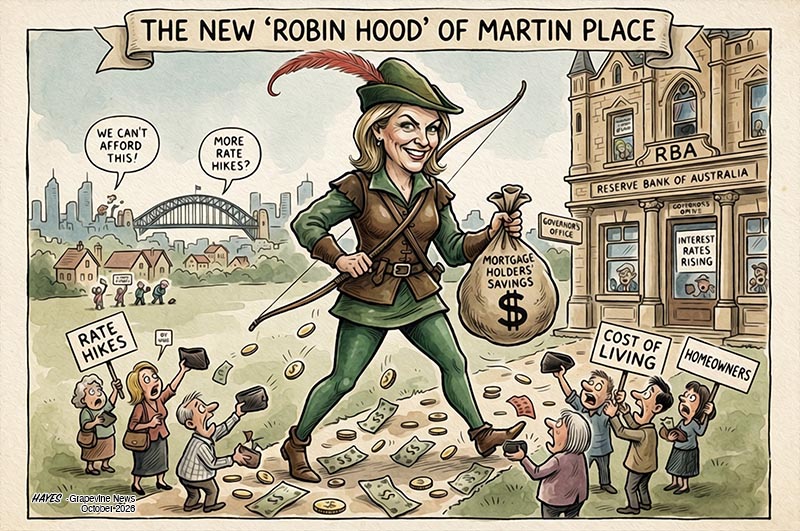
Michelle Bullock insists that rewarding the affluent whilst punishing the poor will curb inflation.
7 October 2026
ALAN HAYES
AS expected, in a highly anticipated press conference, following the RBA board meeting, RBA Governor Michele Bullock, the new Robin Hood of Martin Place, provided a stark assessment of the economy that directly contradicted the political spin coming from Canberra. But what else would you expect from a board that is out of touch with reality and would appear to view middle-class Australians as little more than the ‘serfs’ of the medieval ages.
Bullock made it clear that while global events are an overlay, the fundamental driver of sticky inflation in Australia is domestic.
"Inflation is too high and has been driven by domestic capacity pressures," Bullock stated explicitly, noting that domestic spending and public investment have consistently outpaced the economy's supply constraints. Compounding the crisis, she revealed that aggregate productivity has remained practically stagnant, meaning the domestic economy cannot support growth without generating rapid price increases.
The RBA's blunt positioning effectively stripped away any cover for the federal government's economic strategy, clarifying that further interest rate hikes remain firmly on the table if domestic demand fails to cool down rapidly.
Not surprisingly, Canberra was not having any of Bullock’s rhetoric and, faced with the immediate fury of voters and the business community, came out swinging—quickly launching a media blitz to distance the government from the rate rise. The government’s defence rested almost entirely on factors beyond Australia's borders, heavily leaning on geopolitical instability to justify the domestic economic pain.
Treasurer Jim Chalmers repeatedly pointed to the widening war in the Middle East and the escalation of the conflict involving Iran as the true culprit behind the nation’s inflation woes. Chalmers argued that the conflict had caused global oil prices to surge, a reality that naturally filters down into localised transport, fuel, and grocery costs across every advanced economy.
"Australian workers didn't choose this war, but they are paying a hefty price for it," Chalmers told reporters, while additionally citing the global artificial intelligence boom for driving up international technology supply chain costs.
To defend the government's fiscal responsibility, Chalmers highlighted that the government had successfully delivered two consecutive budget surpluses and removed roughly $200 billion from the projected national debt trajectory. He emphasised that government spending as a share of gross domestic product (GDP) had decreased to roughly 26% under his tenure, compared to the peak of 31% recorded during the height of the pandemic under the previous Coalition government.
Political and academic backlash
The government's heavy reliance on international scapegoats has not held up well under scrutiny. Prominent macroeconomic experts, including UNSW economist Richard Holden, openly accused the Treasurer of actively gaslighting the Australian public. Critics noted that even though tradeable sector inflation (goods affected by international markets) had shown signs of easing globally, non-tradeable inflation (purely domestic services, rents, electricity, and local construction costs) remained dangerously high inside Australia.
Not surprisingly, the opposition jumped right in and argued and seized on the RBA’s commentary to hammer the government's economic record. Shadow Treasurer Angus Taylor labelled the interest rate hike a "dark and devastating day" for millions of working families, pointing out that there have now been 16 interest rate increases since the Albanese government took office.
Taylor rejected the government's global excuses, pointing directly to a massive domestic spending spree within the federal Cabinet Room as the primary driver of excess economic demand. Financial analysts have supported this stance, noting that government spending as a share of GDP currently sits at its highest structural level since 1986, outside of emergency pandemic funding.
The opposition argued that if the government had matched its new initiatives with real spending offsets, the budget would hold a much larger surplus, which would have naturally cooled the overheating economy and prevented the RBA from needing to lift rates to a 15-year peak. The Coalition promised that if elected, they would enforce strict budget rules requiring every dollar of new spending to be completely offset by savings, specifically targeting bloated bureaucracies and inefficiencies within federal programs.
Institutional friction and the road ahead
The public disagreement between the Treasurer and the RBA Governor highlighted an escalating institutional rift. In late 2024, Treasurer Jim Chalmers drew criticism for suggesting that the RBA was "smashing the economy" with interest rate hikes. Now, with the official cash rate sitting at 4.60% and a federal election approaching, the political high stakes are clear.
Anthony Albanese has explicitly refused to implement sudden mid-cycle cuts to public programs or infrastructure projects. He maintains that doing so would hurt employment and weaken essential services. However, leading market economists warn that if the federal and state governments refuse to pull back on demand-heavy spending, the RBA will have little choice but to deliver a fifth interest rate increase before the end of the year.
For the average Australian mortgage holder, the ongoing political debate offers no relief. Caught between sticky domestic prices and a government that continues to point fingers overseas, everyday citizens continue to pay a heavy financial price for the country's stubborn inflation battle.
Crushing households to fix government mistakes
While working-class families struggle to keep a roof over their head, by cutting back on basic essentials, the RBA is using the interest rates tool to exclusively target them. All the while, the affluent keep being rewarded with the ability to earn more from their cash investments.
There is little doubt that the RBA is forcing a financially vulnerable segment of the population to carry the entire burden of trying to curb national inflation.
Meanwhile, both state and federal governments continue to pump billions of dollars into massive infrastructure projects and public spending, directly competing for scarce labour and materials. This government-driven demand is keeping inflation high. Yet, instead of calling out political overspending, the RBA continues to squeeze the household budgets of ordinary citizens.
The continuing downside for struggling families is that we have a prime minister who, lost in the ethereal realm of cloud-cuckoo-land, won’t accept that out-of-control government spending is exacerbating inflationary trends—instead, as we so often see, the blame game becomes the favoured excuse.
And, as the finger-pointing continues, social welfare organisations and financial counsellors report that demand for emergency relief has hit unprecedented levels. Food banks are seeing an influx of double-income, asset-owning families, who can no longer afford both groceries and their monthly mortgage repayment, begging for help.
With another board meeting scheduled for November 3, and the RBA warning that further rate hikes may be necessary, public patience has completely run out. If the RBA continues to rely on theoretical academic models, while ignoring the real-world suffering of everyday families, it risks permanently damaging its credibility. Millions of Australians are crying out for relief, but the decision-makers at the top seem completely unable to hear them.



.jpg?crc=4257584689)


_web.jpg?crc=282450513)


SUBSCRIBE FOR FREE to the Grapevine News Online and to the monthly e-book edition of the Grapevine Community Weekly. Our online news platform and monthly newspaper is about real local news and events. We will not spam you or share your details with third parties.
