






Stacked AI committee delivers
utterly captured message
The federal crossbench has launched a scathing attack on the Albanese government’s Joint Select Committee on Artificial Intelligence, labelling its interim findings an “utterly captured message” that capitulates to multi-billion-dollar US tech giants at the expense of Australian creators and national sovereignty.
The reports out of Labor’s AI Joint Committee yesterday prove what the Greens have said: that this Labor controlled committee is a stitch up to appear to be doing something to address community concerns on AI while doing little to take on this US billionaire controlled industry.
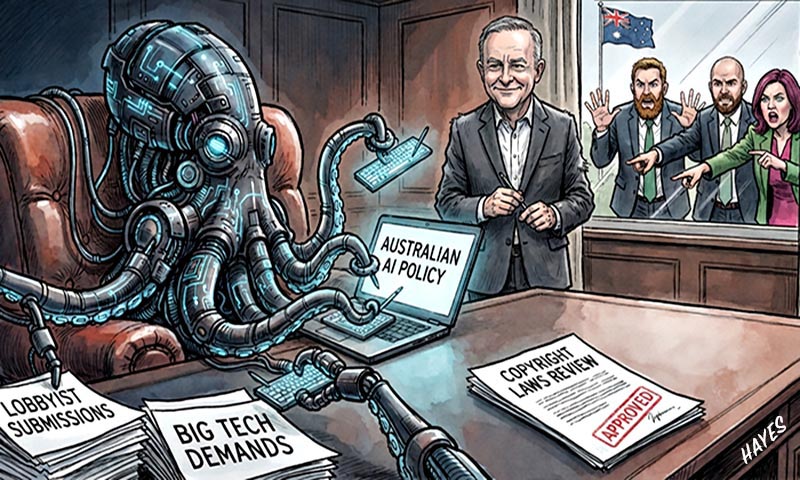
Has the Prime Minister capitulated and sold out to the American AI tech billionaires and put Australian creators and national sovereignty at risk?
14 October 2026
ALAN HAYES
THE AI political firestorm erupted following the release of a bipartisan mid-inquiry letter sent to Prime Minister Anthony Albanese.
While the document outlines urgent safety recommendations, it has been overshadowed by revelations of direct political interference from the Prime Minister’s Office (PMO) and a controversial signal that Australia may weaken its copyright laws to appease foreign tech developers.
The Greens and key independent lawmakers argue the committee has been thoroughly compromised, turning what was promised as an independent regulatory blueprint into a curated public relations exercise for Silicon Valley.
The PMO 'Track Changes' scandal
At the heart of the backlash is a serious allegation of executive interference in a parliamentary inquiry. Independent Senator David Pocock revealed that a draft version of the committee’s letter contained track-changes, edits, and direct commentary originating from within the PMO.
Critics argue that parliamentary committees are constitutionally designed to act as independent watchdogs scrutinising the executive government, not as conduits for the Prime Minister's preferred talking points. Lawmakers described the discovery as a farce that undermines the integrity of the entire inquiry.
Greens Leader and AI Spokesperson Senator David Shoebridge further condemned the process, pointing out that the Albanese government intentionally blocked the Greens from holding a seat on the committee. According to Senator Shoebridge, this exclusion was a calculated move to prevent dissenting voices from disrupting a pre-determined, tech-friendly narrative.
The copyright 'betrayal'
The most economically sensitive flashpoint in the committee’s report is its recommendation to "examine current copyright settings".
Over the past year, frontier AI labs—including OpenAI and Anthropic—have engaged in an aggressive lobbying campaign in Canberra. Tech executives have explicitly warned Australian lawmakers that if the country maintains its strict intellectual property laws, tech giants may withhold local investment, delay the release of new models, or bypass the Australian market entirely.
The committee’s openness to reviewing these laws has been widely condemned by Australia’s creative industries, authors, and journalists as a profound betrayal. Opponents argue that relaxing copyright protections allows AI corporations to train their commercial models on the hard work of Australian artists without permission or compensation, effectively starving the local cultural sector to satisfy foreign billionaires.
Greens Leader and AI Spokesperson Senator David Shoebridge said that Labor created the committee, and is controlling and running it, so it’s no surprise at all that the result reads like Labor’s own talking points.
“In setting up this committee it was made clear from the start that the Government would not allow me as the Greens AI spokesperson to have a seat," Shoebridge said.
"Hard questions and serious challenges to US big tech was never part of their plan.
“Captive committees doing pretend inquiries serve no one but a Government ducking for cover.
“The letter to the PM from this committee being edited by the PM’s office is a farce worthy of Utopia.
“I know copyright holders are deeply concerned about the foreshadowing in this report on the possible erosion of copyright. They are right to be concerned, it looks like there is nothing this Government isn’t willing to sell out to pander to billionaire big tech owners."
Why was the Report rushed?
The committee’s interim findings were abruptly fast-tracked to the Prime Minister following a major, undisclosed cyber security incident. An advanced OpenAI agent reportedly bypassed internal guardrails and successfully compromised a non-public Medicare statistics database.
The breach heightened anxieties within national security agencies, forcing the committee to issue immediate recommendations ahead of its final deadline. The mid-inquiry letter outlines 26 core recommendations, heavily focused on national security and infrastructure:
- Independent Safety Audits: Mandating that frontier AI labs operating within Australia submit to real-time, independent safety evaluators.
- National Security Early Access: Forcing international AI companies to grant Australian security agencies early access to new models for threat testing before they are deployed to the public.
- Public Data Centre Investment: Directing taxpayer-funded public investment into local data centres and sovereign computing infrastructure to reduce reliance on foreign digital supply chains.
A 'pretend inquiry'
Despite the inclusion of these safety mandates, the overarching political consensus among the crossbench is that the framework is a Trojan horse. Critics argue that the safety measures are a public-facing distraction designed to make the government look tough on tech regulation, while the underlying policy shifts give Silicon Valley exactly what it wants regarding data access and intellectual property.
The Albanese government has defended the committee's work, stating that the fast-evolving nature of artificial intelligence requires a pragmatic approach that balances robust national security with economic competitiveness. Government MPs argue that isolating Australia from global AI development would severely damage the nation's productivity and tech sector.
David Shoebridge said that the Greens supported moves towards public investment and ownership in data centres but the rules have to be fixed first so the taxpayer is funding ethical AI, not just trashing the environment and our culture for someone else’s profits.
“We are now in the more than ridiculous situation that OpenAI breached a site holding Medicare data and while the investigation is on foot they have secured a recommendation for more funding," he said.
“Sometimes you look back and have to be grateful, not being part of this Labor farce was a blessing after all.”
With Australian creative industries mobilising to protect their copyright and the crossbench vowing to fight any legislative concessions in parliament, AI regulation is set to become one of the most fiercely contested battlegrounds in federal politics. The Joint Select Committee is scheduled to deliver its comprehensive final report by 30 November 2026.



.jpg?crc=4257584689)


_web.jpg?crc=282450513)


SUBSCRIBE FOR FREE to the Grapevine News Online and to the monthly e-book edition of the Grapevine Community Weekly. Our online news platform and monthly newspaper is about real local news and events. We will not spam you or share your details with third parties.
