





Why Budgewoi’s sick are not to blame
The heavy, chemical tang of the afternoon breeze blowing off Lake Munmorah does not care about statistics, but the people who breathe it do. In Budgewoi, and across the wider Central Coast and Lake Macquarie regions, a toxic narrative has begun to settle over the community as thick and inescapable as the grey dust on their windowsills.
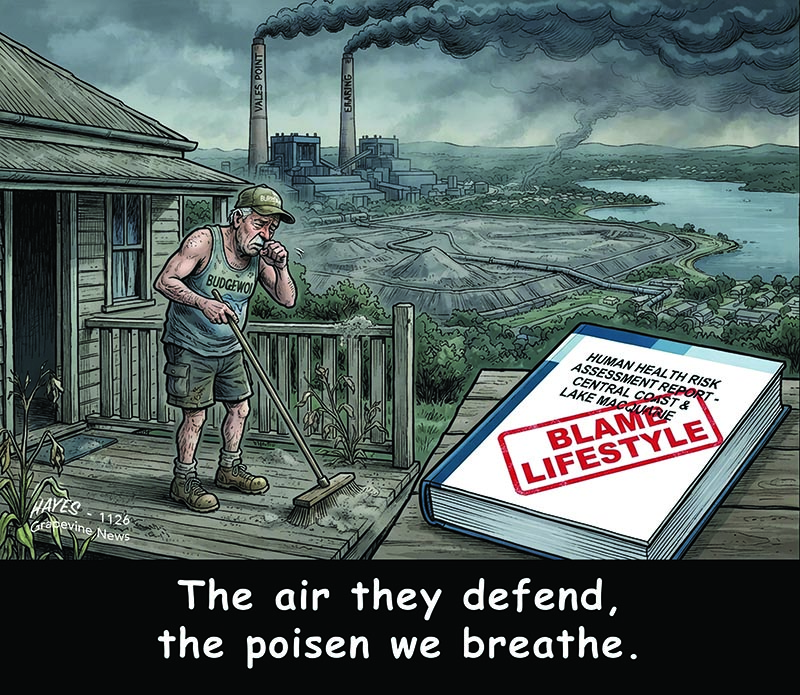
But does our State Government care about the plight of the Central Coast’s northern residents? Apparently not! The recently released Human Health Risk Assessment Report (HHRA) represents a textbook case of government pandering to corporate negligence, acting as a bureaucratic shield for the energy sector rather than a protector of public health. By reducing a catastrophic regional health crisis to a checklist of "poor lifestyle choices," the NSW government and its health agencies have deliberately weaponised epidemiology to clear power station operators of multi-billion-dollar liabilities.
Drawing a definitive, causal link between the Vales Point ash dams and the area's astronomical cancer rates would legally force the state to mandate exhaustive, expensive site remediations. It would open the floodgates to massive corporate compensation claims from devastated families. To avoid this financial and political fallout, the report utilises institutional blindness—conveniently ignoring how heavy metals, asbestos, and PM2.5 particulates systematically destroy human tissue over decades.
This is regulatory capture in its purest form. By delivering a "bill of good health" to corporate polluters, the government has chosen to coddle industrial interests, protect state royalty streams, and insulate corporate ledgers. In doing so, they have abandoned the people of Budgewoi, explicitly signalling that corporate profits carry far more weight than human lives.
4 November 2026
ALAN HAYES
FOLLOWING the release of the final Human Health Risk Assessment Report (HHRA), public health officialdom—embodied by NSW Health and Dr Craig Dalton of Hunter New England Health—offered an explanation for the staggering clusters of chronic illness in the region that felt less like a clinical diagnosis and more like an eviction of corporate liability. By pointing to lifestyle factors such as smoking, diet, and alcohol consumption, authorities effectively shifted the ledger of blame onto the victims.
Yet, to look at the landscape of Budgewoi is to understand that blame cannot logically or morally be affixed to the residents. It sits squarely, heavily, and undeniably on the shoulders of the local coal-fired power stations and the decades of poorly managed environmental contamination they have left in their wake.
To suggest that a community is entirely the author of its own destruction ignores the brutal arithmetic of geography. Budgewoi does not exist in a vacuum; it exists in the immediate fallout zone of heavy industry. For generations, the Vales Point and now-decommissioned Munmorah power stations have loomed over the lakes, their towering stacks venting particulate matter into the sky while their massive, unlined ash dams held millions of tonnes of toxic waste just metres from local waterways and residential backyards. The community group Future Sooner recently brought forward devastating health data exposing the reality of this proximity: lung cancer rates in the area soar at 110 per cent above the national average, while head and neck cancers in Budgewoi itself sit at an astonishing 90 per cent above the baseline.
However, “he good news, we were told by NSW Health," said Gary Blaschke OAM, President Future Sooner and CAHCAC representative, "was that Head and Neck Cancers in Budgewoi had dropped from 102% above the national average to a mere 90%,”
“The bad news was that lung cancer had risen to 110% above the national average.”
When a single postcode exhibits cancer clusters so wildly divergent from national norms, attributing the anomaly purely to individual lifestyle choices is not just a statistical stretch; it is a profound failure of public health logic. If lifestyle factors alone were the culprit, one would have to assume that the people of Budgewoi engage in reckless behaviour at double the rate of almost every other community in Australia. This is a demographic caricature that defies reality. What actually separates Budgewoi from healthier regions is not a collective lack of discipline, but the microscopic invisible rain of heavy metals, sulphur dioxide, and fine particulate matter (PM2.5) that residents have been inhaling every day of their lives. Fine particles do not respect property lines. They bypass the body’s natural filters, embedding themselves deep in lung tissue and entering the bloodstream, driving the exact chronic inflammations and malignancies now devastating local families.
“NSW Health and Dr Dalton admitted that chronic illnesses like lung, liver and blood cancers on the Central Coast and Lake Macquarie were way above the national average but refused or was unable to identify why,” Mr Blaschke said.
“They certainly drew the line at pointing the finger at coal-fired power station emissions and their ash dams. Instead, they blamed the community for getting sick. Apparently, it’s because, as Dr Dalton pointed out, residents are chain-smoking alcoholics."
The "lifestyle defence" completely crumbles when confronted with the legacy of hazardous waste storage at these industrial sites. Consider the case of the Vales Point ash dam, a sprawling repository that holds far more than just coal by-product. For decades, it served as a disposal ground for tens of thousands of cubic meters of asbestos. In nearby Swansea and Caves Beach, mesothelioma rates are documented at 98 per cent above the national average. Mesothelioma is not a disease of "lifestyle". It is not caused by poor diet, a lack of exercise, or alcohol consumption. It is caused by asbestos. To argue, as the official health findings imply, that there is no connection between a massive, local asbestos dumping ground, and a near-doubling of a rare asbestos-related cancer, is an exercise in institutional blindness. It is treating the community as nothing more than ignorant sheep. It asks the community to believe in an impossible chain of coincidences, while at the same time exonerating the primary source of the carcinogen.
“When it comes to Mesothelioma, Swansea-Caves beach for example, has 98% above the national average. And NSW Health said that had nothing to do with 61,770 cubic metres of Asbestos that was dumped on Vales Point ash dam. So, I guess it’s because all those grannies are pulling down their fibro homes; you can’t blame the smokers this time." said Mr Blaschke.
“And so, with NSW Health, and the government’s support, the HHRA final report delivered a bill of good health for the Central Coast and Lake Macquarie ignoring all the statistics, including the government’s own, gaps in the report, and medical and scientific evidence.”
The power stations have historically operated under regulatory frameworks that favoured economic output over stringent environmental health protections. For years, NSW power stations were permitted to emit levels of toxic air pollutants—including nitrogen dioxide and sulphur dioxide—that would be illegal in parts of Europe, the United States, and China. The accumulation of coal ash, a concentrated sludge containing arsenic, lead, mercury, and selenium, represents a ticking ecological time bomb. These heavy metals do not evaporate; they leach. They migrate through porous groundwater networks, bioaccumulate in the fish and mud of the lakes where local children swim, and dry out into fine dust that the wind carries directly into the streets of Budgewoi. When the state allows industry to operate with such permissive thresholds, the resulting health crisis is a structural certainty, not a personal failure of the citizenry.
Affixing blame to the residents also ignores the profound socio-economic realities of the region. Many families moved to the Central Coast precisely because it offered affordable housing and employment within the energy sector. They trusted that the regulatory bodies tasked with oversight would protect their air and water. Instead, they have been left to carry the physical burden of the state's historical reliance on cheap coal power. When public health agencies publish reports that focus heavily on individual behavioural modifications, while downplaying systemic industrial pollution, they are performing a convenient political function. They are absolving the corporate operators of the power stations from the immense financial liabilities of comprehensive remediation and healthcare compensation. They are also shielding successive state governments from admitting that their regulatory oversight was catastrophically inadequate.
It is a cruel irony to tell a population suffering from elevated respiratory and oncological illnesses that they simply should have lived better. A person can quit smoking, but they cannot quit breathing the air outside their front door. A parent can cook nutritious meals, but they cannot filter the groundwater leaching from an unlined ash dam into the local ecosystem. The choices available to an individual are entirely constrained by the environment they inhabit. When that environment is systematically degraded by heavy industry, the concept of "personal choice" becomes a myth used to silence dissent.
They have “ blamed everything on the residents for getting sick, not the coal-fired power stations and their ash dams for making them sick. Nothing to see here. Business as usual. Why are we not surprised?” Mr Blaschke said.
The responsibility must be returned to where the smoke originates. The power stations have reaped decades of commercial profit from the extraction and burning of coal, leaving the public to internalise the medical costs. True accountability means recognising that the health crisis in Budgewoi is an environmental injury, not a lifestyle disease. The staggering cancer percentages are not a reflection of community vice, but a map of industrial exposure.
Until health authorities stop treating the residents of the Central Coast as the architects of their own sickness, and start holding the energy infrastructure accountable for its toxic footprint, the grey dust will continue to settle—not just on the windowsills of Budgewoi, but on the very integrity of public health in New South Wales. The blame belongs to the stacks, the dams, and the corporate ledgers that put production above human life. It is time the state stopped asking the victims to apologise for breathing.





SUBSCRIBE FOR FREE to the Grapevine News Online and to the monthly e-book edition of the Grapevine Community Weekly. Our online news platform and monthly newspaper is about real local news and events. We will not spam you or share your details with third parties.
